虛雲老和尚畫傳集(上卷)
《虛雲老和尚畫傳》序
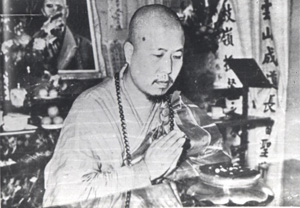
圖片說明:上人瞻仰虛老舍利
《釋迦如來應化事迹》一書問世久矣,為教門中之偉作,眾生界之寶筏,人人樂讀,個個願觀,容易明瞭;誠對機之善本,契理之妙論。
今為仰慕上虛下雲老人道德、戒行、學問、智慧、苦行、願力、實行、慈悲、喜捨、平等、布施、忍辱、精進、禪定諸波羅密門,一生之奇特事蹟,堪為末法之指南,斯世紀之救星。故而不惜重資,聘專家繪畫佛教人材,精美國畫二百餘幅。竭數寒暑之精思設計,今始告成問世。藉此將老人道德,推行於全世界。人手一編,家喻戶曉,以此而發菩提心,以此而成無上道,以此而倒駕慈航,教化眾生,皆得不退轉於菩提覺位矣。
Preface
The Life Story of Shakymuni Buddha has long been circulating in the world, and it is considered a masterpiece within the Teachings, a precious raft upon which living beings can pass beyond this realm. Everybody likes to read it; one and all are delighted by the pictures that accompany the text. The book is easy to understand, truly a magnificent work that responds to potentials, a wondrous exposition that tallies with principle.
The author has long cherished a deep admiration for his teacher, Venerable Hsu Yun. This admiration extends to the Master's Way virtue, precept conduct, erudition wisdom, ascetic discipline, vow power and actual practice. It includes the Master's kindness, compassion, joy, and renunciation, his equanimity, giving, patience, vigor, Dhyana samadhi, as well as all the other Paramita doors. The numerous events that happened throughout his life can certainly act as a compass for those in the Dharma-ending Age, a saving force for this century.
Therefore, the author found an especially talented artist in Buddhist subjects, in preparing 200 scrolls, and after several years of careful planning and deliberation, this book has now been published. It is my hope that the Venerable Yun's virtuous conduct will be made known to the entire world. May many people through reading his life story be encouraged to bring forth the Bodhi resolve and accomplish the unsurpassed Way, and then, may they reverse the boast of compassion to come back and teach and transform living beings, so that together we attain irreversibility from the position of enlightenment.
觀音前求子
雲公老和尚。俗姓蕭。乃梁武帝之後。世居湖南。湘鄉。父玉堂。母顏氏。清道光初年。父以科舉出身。宦於閩。年逾不惑尚無子。父母憂之。遂以虔誠懇切之心。進香祈子於城外之觀音古廟中。
宣化偈曰:
積功樹德植善因。虔心求子禮慈尊。
萬慮澄清惟當念。一心不亂感而應。
Seeking a son before Avalokiteshvara Bodhisattva
The Venerable Master Yun's lay name was Hsiao. His ancestors, who came from Lan Ling (Fragrant hills ), were descendents of Liang Dynasty Emperor Wu, and had for generations dwelt at Hsiang-hsiang in Human province. His father's name was Yu T'ang and his mother was the Yen of the family. In the first year of the Tao Kuang reign period of the Ch'ing Dynasty (A.D. 1821), His father entered in to public service as a K'e Chu ( a grade in the Governmental Examination system) and became a public official in Fukien Province. When he was past forty years of age, he was still without a son. This grieved him and his wife, so with sincere words and sorrowful hearts, they offered incense and sought a son before the Avalokiteshvara Shrine in an ancient temple outside the city.
The verse says:
Amassing merit, establishment virtue, a wholesome seed was planted.
Sincere in heart, they sought a son and bowed to compassionate one.
Ten thousand anxious thoughts were stilled and only one remained.
Single mindedly unconfused, they effected a response.
重修寺院橋樑
玉堂夫婦頂禮菩薩。祈願畢。參觀寺容。發現殿宇竟已殘頹。瓦破牆傾。聖像漏成汗流滿面狀。心頗不安。爰發願重修。復見永春東關之橋。年久失修。行人感懷危險戒心。即僱工興建寺橋。煥然一新。
宣化偈曰:
修福修慧修寺廟。修道修德修橋樑。
修因修果修諸己。修善修仁修自強。
Rebuilding the temple and bridge
After Mr. and Mrs. Hsiao prayed and made vows in their worship of the Bodhisattva Avalokiteshavara, they looked around the temple at the Buddha images. They saw that the main temple was ruined and useless; the tiles were broken and the walls had fallen over. Water from leaks sweat down the faces and bodies of the holy images, doing damage. Because this greatly troubled them, they resolved to repair the temple. They also saw that the Eastern Bridge of Yung Ch'un Chou had fallen into disrepair over the years. Those who used it were worried and wary of its danger. Thereupon Mr. and Mrs. Yu T'ang hired workmen to reconstruct and restore the temple and bridge.
The verse says:
Build up blessings, build up wisdom by building temples and shrines.
Build the way, build up virtue by building bridges, too.
Building causes builds effects. Build it within yourself.
Build the wholesome, build humaneness, build up your self-reliance.
同得奇異兆
一日玉堂夫妻。見寺橋工程完竣。甚悅。是夕同夢一著青袍。修髯之長者。頭頂觀音。跨虎而來。躍登榻上。驚醒互告。自是遂有娠。喜念佛。誦經拜懺等。親近善知識。遠離諸惡法。樂善不倦。
宣化偈曰:
跨虎入胎世間稀。頂上出現丈夫軀。
覺悟同倫常精進。普度含識不休息。
Seeing the same rare portent
One day, Mr. and Mrs. Yu T'ang were pleased to see that the construction of the temple and the bridge had been completed according to design. That evening they both dreamt of a dark robed, long-bearded sagely cultivator, who , astride a tiger and with Avalokiteshvara Bodhisattva atop his head, pounced upon the bed. Startled awake. They recounted their experience to each other. Afterwards, Mrs. Yu T'ang was pregnant. They happily recited the Buddha, and drew near Good ad Wise Advisors. Leaving evil dharmas far behind, they engaged in charitable deeds without weariness.
The verse says:
Astride a tiger, entering the womb, came one seldom found in the world.
Manifesting atop his head was the compassionate hero's form.
Enlightening five kinds of fellow-beings with ever-advancing vigor.
He went everywhere saving those with sentience, and never stopped to rest.
調佐泉州職
次年公父以政績優異。服務盡職。廉潔明敏。造福人群。上級提拔。轉調佐泉州。深達民心。宣德達情。化行俗美。盡力興辦福利社會事業。注重實際。不尚虛文。雖置身名利場中。而不為名利所搖動。奇哉。
宣化偈曰:
宦海浮沈何足言。榮辱名利任變遷。
滄海桑田尚無定。歷史志書豈盡然。
Being transferred to assistant prefect in the Ch'uan Chou government
The following year, because of his outstanding achievements in government service, because he completely fulfilled his duties, because he was incorruptible and quick-witted, and because he brought happiness to the common people, the Master's father was promoted and transferred to Ch'uan Chou, where he became the assistant to the Prefect. Profoundly understanding popular sentiments, he won the hearts of the people, and instilled virtue in living beings. He influenced people so that the customs became lofty and wholesome, and tapped his strength to undertake endeavors beneficial to society. He was not fond of empty talk, and although he worked within the sphere of fame and profit, he was not in the least turned or motivated by them. He was truly a remarkable person.
The verse says:
Afloat on the sea or politics, how can it all be told?
In honor or shame, Profit or fame, he bore the shifts and
Changes at sea or in the mulberry fields - wherever he was found -
How could historical records and annals document it all?
菩薩誕生於世
歲次庚子七月卅日寅時。顏氏夫人產期已至。誕生公焉。公出世為一肉團〈八地菩薩方有此境界〉。母駭且慟。以為無復舉子望。即氣壅死。翌日有賣藥翁訪。遂破之得男嬰。即雲公誕生之情形。
宣化偈曰:
來本未來生無生。兜率內院降雲公。
彌勒咐囑興佛法。釋迦授記振宗風。
Witnessing the birth of a Bodhisattva into the world
The next year, between three and five a.m. on the 30th day of the seventh lunar month (August 26, 1840), Mrs. Hsiao went into labor and gave birth to the Master. He entered the world in a caul, a state had only by eighth stage Bodhisattvas, which caused his mother alarm. Thinking that there was no hope of her ever bearing children again, she died in grief. The next day, the family was visited by an old medicine peddler who, upon opening the mass of the flesh, removed a male child. These are the circumstances surrounding the birth of the Master Yun.
The verse says:
He came and yet did not come; he was born and yet not born.
From the court of Tushita Heaven, the Master Yun descended,
Instructed by Maitreya Bodhisattva to bring forth the Buddha's Dharma.
Shakyamuni Buddha predicted that he would save the schools' repute.
孩提時期
公庶母王氏撫育。清道光廿年一歲。漸長。遊戲輒以聚土為菩薩像等拜之。讀書課餘喜閱佛經善書修身格言。有關身心性命之學。尤為好樂。此足徵公得天獨厚。賦性非凡。
宣化偈曰:
遊戲讀書露性天。好樂聖典豈偶然。
於斯已悟真俗諦。不二法門願荷擔。
Bringing up the child
The Master's stepmother, who was from the Wang family, took care of his upbringing. The 20th year of the Tao Kuang reign period in the Ch'ing Dynasty (1840) was his first year. When he played during his childhood, he instinctively made Bodhisattva images out of dirt and bowed to them. He was quite happy to peruse Buddist Sutras and works on morality, self-cultivation, and wise sayings . Studies concerning the moral conduct of body and mind especially interested him. His preternatural gifts were developed and subtle – not all common.
The verse says:
Whether playing or reading books, in all he did, his character and inclination were revealed.
The pleasure he took in the sagely scriptures-how could it be by any chance?
Just right here he awakened to the Actual and mundane Truths.
And thus he vowed to undertake the Non-Dual Dharma-door.
兼祧娉二室
道光三十年庚戌公父回泉州。祖母周年老。望見孫媳之心甚切。以公兼祧繼叔為定二室。一為田氏。一為譚氏。二室皆湖南湘籍。仕宦於閩。本為世交。復成親眷。循父母之命。媒妁之言。訂婚納禮矣。
宣化偈曰:
宜爾室家敘天倫。幽嫻貞靜女中英。
淨業圓修法伴侶。無人無家無色空。
Betrothals to two girls aimed at carrying on the lineages of two families
In the 30th year of the Tao Kuang reign period (1850), when the Master was eleven years old, his father returned to Ch'uan Chou. The aging grandmother of the Chou clan was determined that her grandson would have a wife. In order to continue his uncle's lineage as well, the Master was to become heir to two lineages, and so it was that one woman from the T'ien family and one from the T'an family were promised in marriage. Both families, originally from Hsiang-hsiang County in Hunan Province, were Mandarins residing in Fukien Province and had remained friends for generations. All of the relatives and in-laws approved of the fathers'choices. So following the orders of his parents and the words of the matchmakers, he was betrothed.
The verse says:
It is proper and fitting that families should accord with natural relations.
Quiet and graceful, chaste and tranquil, they were exceptional women.
Pure in action, perfecting cultivation, they were comrades in the Dharma,
Without any selves, without any home. without any form or space.
巨鯨朝法駕
咸豐元年二月因事。公父赴台灣。公亦偕往。乘小洋船航至茫茫無際大海。突見如山橫阻之巨鯨。長達數里。眾皆畏之。同聲稱念南無大悲觀世音菩薩名號。須臾見其鯨尾沒於海中。
宣化偈曰:
天龍恭敬不為喜。巨鯨朝拜亦平常。
愚者無知稱為怪。知者有眼窮法源。
A huge whale yielding to the Dharma boat
In the second lunar month of the first year of the Hsien Feng reign period (1851), the Master's father went to Taiwan to transact some business, and took his son, then twelve, with him. They boarded a small ocean-going vessel and sailed into the open sea where they soon encountered a monstrous whale, which looked as broad as a mountain. All on board became alarmed and all together they began to recite the name of the greatly compassionate Avalokiteshvara Bodhisattva (Kuan Yin). In a short time, the whale sank into the depths.
The verse says:
If the dragons of heaven make obeisance, it is nothing to delight in.
How much more is the submission of a giant whale just a common affair.
Foolish people do not know and think of this as strange,
While those who understand have eyes and tap the Dharma's source.
初見佛法僧三寶
公年十三歲。祖母周太夫人棄世。公隨父扶柩回鄉安葬。請僧作佛事。公初見佛即拜。看經則喜。睹僧恭敬。一切法器把玩不捨。若有感悟而不自知之狀態。
宣化偈曰:
永言孝思古今傳。慎終追遠報恩虞。
仰承三昧加持力。河沙罪業悉消蠲。
First meeting with the Triple Jewel —
the Buddha, Dharma, and Sangha
When the Master was thirteen, his grandmother Chou died and he accompanied his father to escort the coffin back to Hsiang-hsiang County for burial. The Sangha was invited to perform Buddhist rites. Upon first seeing an image of the Buddha, the Master immediately bowed; the sight of the Sutras elated him and when he met the Sangha, he acted with deference. He tried each of the ceremonial instruments and did not want to stop playing them. It was as if he had suddenly come to an understanding, and yet he himself did not appear to be aware of it.
The verse says:
Eternal words and filial thoughts are transmitted from past to present.
He carefully performed ancestral rites, sincerely repaying compassion.
Relying upon samadhi's power of aiding and maintaining,
Offenses as numerous as Ganges sands were completely wiped away.
看香山傳發心出家
公家中藏有古書甚豐富。檢閱中得香山傳一冊。內容乃言觀世音菩薩之事蹟。讀後所受影響甚深。於是決意將來出家修道。不羨紫綬之榮。不求朱門之富。淡泊以明志。清高而立行。
宣化偈曰:
發菩薩心悟本然。胸懷壯志凌霄漢。
而今亦有香山傳。如公之志望後賢。
Reading the Story of Incense Mountain and resolving to leave the home-life
The storerooms of the Master's house were full of very old books. Looking them over, he found a volume called the Story of Incense Mountain, which described the life of Avalokiteshvara Bodhisattva (Kuan Yin). Upon reading it, he was deeply influenced and was determined to go forth from home in the future to cultivate the Way. He did not long for the honor of the Purple Cord (of an official), nor did he wish to have a red door indicative of wealth. He decided that a life of simplicity would exemplify his resolution to practice pure and lofty ideals.
The verse says:
Resolving his thoughts on the Bodhi mind, he understood what is basic.
This ideal he firmly embraced, beyond the rise of galaxies.
Now there is a sequel to the Story of Incense Mountain,
By which others will be inspired to seek sagehood in the future.
南嶽古剎進香
壬子歲八月隨叔父蒲堂。進香南嶽衡山諸名勝。古剎朝拜菩薩。每有所至。則恍若舊地重遊。夙昔所識之家門者。然以此推之。公或宿世生中。主化南嶽。教諸眾生。咸令發心精進勇猛求無上道。
宣化偈曰:
南嶽衡山妙高峰。歷代相傳出聖僧。
三生石伴誰識誰。萬劫生中親復親。
Offering incense in the ancient monasteries of Nan Yo
In the eighth lunar month of the cyclical year Jen Tuz (1852), the Master, at thirteen, joined his Uncle on a pilgrimage, visiting temples. He offered incense at all of the famous places of Heng Shan, Nan Yo Mountain, and bowed to the bodhisattva in the ancient shrines. As if he were roaming through familiar ground, he was happy wherever he went, and was attracted as if seeing relatives whom he had known in the past. Who knows? Perhaps in a previous life, the Master was at Nan Yo Mountain, teaching and causing living beings all to resolve themselves on vigorously and courageously seeking the Unsurpassed Way.
The verse says:
Nan Yo (Southern Peak), Heng Shan Mountain-that marvelous towering peak-
Is where the successive transmission produces sagely monks.
The granite friends of the past, present, and future-who recognizes them?
Within the lives of ten thousand kalpas, relatives return to relatives.
父命修習外道
咸豐三年公父測其報出世意。遂請外道術師教其在家煉吐納術。免其日後出家。但公生具擇法眼。不樂於此。蓋外道與佛教大有背道而馳。隔靴搔癢。公天生純孝。父命不違。姑權遷就而已。
宣化偈曰:
三千旁門逞絕技。九六外道顯玄妙。
誰知公具擇法眼。是非邪正立劃焉。
Being ordered by his father to practice other religions
In the third year of the Hsien Feng reign period (1854), when the Master was fourteen, his father, hoping to prevent him from leaving the home-life, engaged a Taoist sorcerer to tutor him at home in the devices of alchemy, exhalation and inhalation. From that time on, he was prevented from leaving the home-life. However, the Master's innate Selective Dharma Eye would not let him be content with this situation. He saw that the externalist teaching was inferior to Buddhism's great renunciation and wished no part of it. He thought the externalist teaching was about as effective as scratching an itch through one's boot. But the Master was sincerely filial and didn't disobey his father's commands. He remained tolerant and compromising.
The verse says:
Three thousand extraneous doors reveal their special skills.
Ninety-six other religions display their wonderful metaphysics.
Who would have guessed that the Master had the Selective Dharma Eye,
And so could distinguish clearly right from wrong, improper from correct.
潛然離家不果
公年十七已被困習外道三年矣。心中悵甚。常思出家為僧。一日乘叔外出不覺之際。潛逃往南嶽。古剎中剃度出家。豈料於迂迴歧途中。遭叔父使人所截回。私願未果勸送歸家。
宣化偈曰:
脫俗離塵效希達。孰意崎嶇徑路狹。
更無寶驥天王助。終被截回仍歸家。
Attempting to leave home secretly, he was unsuccessful
When the Master was seventeen years old, he had already undergone the hardships of practicing Taoism for three years and was indeed disappointed. He constantly thought about leaving the home-life and joining the Buddhist Sangha. One day he took advantage of his uncle's absence to furtively flee to Nan Yo. His intent was to shave his head in an ancient temple and officially leave the home-life. Little did he know that on a winding mountain path he would encounter envoys sent by his uncle to intercept him and escort him back. His aspiration was not realized and he was reproved and brought back home.
The verse says:
Renouncing the vulgar and leaving the dust, he strived to be like Siddartha.
Who would have guessed that the rugged mountain had a path steep and narrow!
Moreover, he lacked the Precious Thoroughbred and the aid of the Heavenly King,
So in the end he was overtaken and went back home again.
談法度雙妻
公至家中。恐公再度出走。乃送公及其從弟富國至泉州。公父乃迎娶田譚二氏為公完婚。而公已空色相。無我無人慾念毫無。心清體淨。故雖同居而無染。更為二氏廣說佛法。化度其為佛徒。
宣化偈曰:
雙宿雙棲順世俗。一心一意求菩提。
夫無染緣妻淨侶。在塵出塵調御師。
Speaking Dharma to cross over his two wives
When the Master arrived home, it was feared that he would again escape, so he was sent with his first cousin Fu Kuo to Ch'uan Chou. His father formally received brides from the T'ien and T'an families for the Master, and the Master's marriage was completed. The Master, however, had already realized the emptiness of form. He held no view of a self or of others and had not the slightest thought of desire. He was clear of mind and pure in body. Therefore, although they dwelt together, he remained undefiled. Moreover, the Master extensively explained the Buddhadharma for the two women so that they became disciples of the Buddha.
The verse says:
In living and dwelling together, he complied with the vulgar world,
But with single-minded, lone intent, he sought enlightenment.
Since there was no defilement, his wives were pure companions;
Both in the world and beyond it, he was a Master Tamer.
離俗偕從弟
公與從弟富國手足情深。兄友弟恭。富國對佛法亦素有研討。故與公志同道合。趣味相投。是以於十九之年探悉福州鼓山之旅程。偕富國同往。別時作皮袋歌一章贈田譚二氏。
宣化偈曰:
佛化堂弟度阿難。公偕富國上鼓山。
殊途同歸一鼻孔。彼丈夫兮我亦然。
Being accompanied by his cousin Fu Kuo, he leaves laylife behind
Between the Master and his first cousin Fu Kuo was a deep bond of brotherly friendship and respect. Fu Kuo also had previously explored the Buddhadharma and had the same aspiration as the Master, so they amicably traveled the Path together. In his nineteenth year, the Master, accompanied by Fu Kuo, started the journey to Ku Shan (Drum Mountain) in Fu Chou to leave home. Before leaving, he wrote the "Ode to the Skinbag" which he left behind for the T'ien and T'an women.
The verse says:
The Buddha instructed his first cousin, crossing Ananda over.
The Master brought along Fu Kuo and ascended Ku Shan Mountain.
Although from different walks of life, they shared the same intent.
How like the courageous heroes of old was the Master Yun!
受具足寶戒
至鼓山湧泉寺。禮常開上人為披剃師。依妙蓮和尚圓受具足戒。名演徹又名古巖號德清。自出家受戒潛修秘行。窮究教理大乘起信論等典籍。擇其要者而修之。撮其精者服膺之。
宣化偈曰:
受戒即入諸佛位。持戒清淨如月圓。
身口意業無瑕疵。捨我雲公其誰擔。
Receiving the invaluable complete precepts
Upon reaching Yung Ch'uan (Bubbling Spring) Monastery on Ku Mountain, he bowed to the High Master Ch'ang K'ai (Eternally Open) as his teacher under whom he donned the monastic robes and shaved his head. He received the complete Bhikshu precepts under the auspices of the Venerable Master Miao Lien (Wonderful Lotus) and was given the names Yen Ch'e (Extensive Penetration) and Ku Yen (Ancient Cave) as well as the designation Te Ch'ing (Pure Virtue). After leaving the home-life and receiving the precepts. he withdrew and began cultivating in seclusion. He exhaustively investigated the principles of the Shastra entitled The Arising of Faith in the Mahayana as well as various Sutras, trying to select and embody their essential points.
The verse says:
He received the precepts and immediately entered the position of all the Buddhas.
Maintaining the precepts purely and clearly, just like the round full moon,
His karmas of body, mouth, and mind were free from flaw or blemish.
Who else besides our Master Yun is able to be like that?
置身巖穴潛修
是時公父在泉州。遣多人到處尋訪。富國自受戒後即束裝就道。行腳參方不知其踪跡。而公則放下身心隱居後山。人跡罕至。虎狼時出深山窮谷岩穴洞中。飢食樹毛松子。渴飲清泉溪水。
宣化偈曰:
岩穴苦修耐歲寒。謀道忘食衣不全。
虎狼同遊為法護。萬佛寶懺拜三千。
Settling in a cliff cave and cultivating in seclusion
At that time, the Master's father at his home in Ch'uan Chou enjoined a number of men to search for the Master. After receiving the precepts, Fu Kuo packed up and began his explorative journey on foot. It is not known where he went in his travels for study. The Master had put down his body and mind and sequestered himself on the back side of a mountain. The people who came to see him were few indeed; however, there were tigers and wolves who came from deep in the mountains and valleys to the caves on the cliff. The Master ate pine nuts when hungry, and when thirsty drank pure spring water.
The verse says:
Ascetic cultivation in a cave on a cliff, he endured the years of cold.
For the sake of the Way, he neglected eating; his robes were ragged and torn.
Tigers and wolves came to his side and protected the Dharma for him.
He bowed the Ten Thousand Buddhas' Repentance three thousand times.
受命服務常住
公年二十三歲禮懺已三載。僧來告云。蕭大人已告老還鄉。妙老和尚深讚公之苦行道心。然需福慧並重。事理兼明拜懺乃慧邊事。任責常住服務僧坊。為大眾謀利益即福邊事。
宣化偈曰:
十方常住三寶尊。百般職務各盡心。
福慧兼修培自性。賢聖同居號叢林。
Being ordered to serve the Eternally Dwelling
When the Master was twenty-three years of age, he had completed three years of bowing the repentance ceremony. One day a Sangha member came and said, "Your father has resigned his post because of his age and has returned home. The Venerable Master Miao Lien applauds your austerities and determination on the Path of cultivation. However, he says one must have both wisdom and blessings and one must understand phenomena as well as noumena. On one hand, bowing the repentance ceremony as you have done leads to wisdom, but on the other, you should attain blessings by undertaking the responsibility of serving those of the monastery, that is, of benefitting everyone and the Triple Jewel."
The verse says:
The Eternally Dwelling of the ten directions is the honorable Triple Jewel.
Performing his duties for the sake of all, he always did his best.
The Master cultivated both blessings and wisdom, enriching the self-nature.
Where worthy sages dwell is called a Buddhist monastery.
勤勞種菜供僧
公任水頭已即改充當菜園之園頭。凡一切蔬菜種植必細心研究其種籽良否。地質肥沃否。栽秧壓蔓合時否。栽者培之。傾者扶之。並以大悲聖水灌溉園蔬作食此菜者速得無生。
宣化偈曰:
服勞執役任園頭。以身示範啟顓蒙。
當知今日人天師。功在鼓山老圃中。
Tirelessly laboring to raise vegetables to offer to the Sangha
The Master undertook the responsibilities of water boy, and then became the gardener. It was necessary for him to examine each vegetable plant to see whether or not it was well hoed, fertilized, and ready to be transplanted or not. He bolstered the plants and braced those which fell over. He irrigated the vegetable garden with water sanctified by the Great Compassion Mantra, so that those who ate these vegetables would quickly realize the unproduced.
The verse says:
He toiled in service attending to the tasks of vegetable gardening.
An exemplar of the regulations, he was an inspiration to the ignorant.
You should know that today's teachers of gods and men
Are supported by the gardener of Ku Shan Mountain.
行堂
諸方叢林清規。上殿過堂。列為要務。如來亦重食時。故著衣持缽入城乞食。我國氣候冷暖不勻。故僧制過堂食齋。而有行堂之苦行單。皆為真發菩提心者爭而任之。以期結十方緣。
宣化偈曰:
普賢大士調眾味。觀音菩薩任天廚。
文殊彌勒同應供。清淨大海飯食忙。
Serving as attendant of the hall
The pure rules of eating in the formal style are an important concern of all Buddhist monasteries. When the Tathagata wished to eat, he donned his robe, took his bowl, and entered the city to make his begging rounds. However, since the conditions and climate of China are not the same as those of India, the Sangha members practice abstention in their eating and accord with the regulations of the formal style. The Master undertook the difficult duties of being the monastery's steward. With his mind set on enlightenment, he waited on tables in order to bear his share of responsibility. During this time he tied up conditions with many beings of the ten directions.
The verse says:
Great Bodhisattva Universal Worthy blends the myriad flavors,
As Kuan Yin Bodhisattva manages the heavenly kitchen.
Manjushri and Maitreya Bodhisattvas together respond to offerings,
While the sea-like assembly of Bodhisattvas are engaged in taking their meal.
逆來順受如如
虛雲老和尚畫傳集
A Pictorial Biography of the Venerable Master Hsu Yun
上宣下化老和尚著述 by the Venerable Master Hsuan Hua
逆來順受如如
乃謁月朗和尚。詢山中事後。即請代職。公不允。亦不言墮水事。祇求在堂打七。該寺家風嚴峻。請職拒就者。以慢衆論。於是表堂打香板。公順受不辭。而病益烈。流血流精不止。以死待之。
宣化偈曰:
橫逆相加處泰然。受辱不怨古聖賢。
放下身心求諸己。根塵識境立消蠲。
Remaining thus, thus unmoving he accepts adversity
The Master called on the Abbot Yueh Lang who, after inquiring about the others on the mountain, requested that the Master assume a staff position for the forthcoming meditation session. The master politely declined, not mentioning his fall into the river. He asked just to be allowed to take part in the meditation. The rules in this monastery were very strict. The refusal to accept responsibility is considered an insult to the members of the monastery. Therefore, the Master was beaten with the incense board in the hall. He quietly accepted this punishment, but his sickness was aggravated. Blood and semen drained from his body. The Master silently awaited his own death.
The verse says:
Against overbearing the odds and adversity, calm and composed he remained.
He accepted insult without complaint or resentment, just as the ancient worthies before him.
By putting down both body and mind, he sought within himself;
The roots, dusts, and consciousness, all disappeared.
看破放下自在
虛雲老和尚畫傳集
A Pictorial Biography of the Venerable Master Hsu Yun
上宣下化老和尚著述 by the Venerable Master Hsuan Hua
看破放下自在
在禪堂精勤參究。澄清一念。放下身心。二十餘日。衆病霍然。旋采石磯。住持德岸。送衣物來供。見公容光煥發。大欣慰。乃舉公墮水事告衆。衆皆欽歎。禪堂內職。不令公輪值。甚得用功。
宣化偈曰:
內無身心外無苔。菩提非樹鏡非台。
悟得本來無一物。此身便是活如來。
Gaining self- mastery, he sees through everything and puts it all down
The Master worked persistently during the session, and with the lucidity borne of single- mindedness, he saw through both the body and mind. In twenty days, he was completely cured of all illness. When Abbot Te An (Virtue of the Other Shore) of the temple near the Ts'ai Shih Jetty arrived with offerings of clothing and supplies, he was greatly surprised to see the Master so radiant. He told the assembly about the Master's fall into the water. Thereupon, the Master was commended and excused from staff responsibilities of running the Ch'an hall. This freed him to work even harder.
The verse says:
Within, there is no body or mind; outside, there are no objects.
Bodhi is not a tree, and the mirror lacks a stand.
If one enlightens to the basic fact that originally there isn't a thing,
Then the body is transformed and becomes a living Tathagata.
洞澈內外光明
虛雲老和尚畫傳集
A Pictorial Biography of the Venerable Master Hsu Yun
上宣下化老和尚著述 by the Venerable Master Hsuan Hua
洞澈內外光明
萬念頓息。工夫落堂。晝夜如一。行動如飛。一夕放晚香時。開目一看。忽見大光明如晝。內外洞澈墻垣。見香燈師小解。西單師在圊中。遠及河中行船。兩沿樹木。種種色色。悉皆了了見。
宣化偈曰:
無無亦無湛然空。空無所空內外通。
行人欲識真消息。制之一處死復生。
Being permeated by light inside and out
His numerous thoughts had suddenly ceased, and the Master's spiritual skill began to develop. When walking, he felt as if he were flying; night and day had merged into one. After meditating one evening, the master opened his eyes, and suddenly, everything both inside and out the monastery walls was penetrated with the brilliance of daylight. He was able to see the Verger urinating outside and the guest monks in the washroom. Off in the distance were the boats plying on the river, and he could see the trees on both banks, among many other things; all with perfect clarity.
The verse says:
Nothing, nothing and nothing again-still, lucid and empty.
But the emptiness lacks that which is emptied; in and out are the same.
If you wish to know this true bit of news, cultivators of the way,
Direct your efforts toward one single goal, and after death, come alive again.
詢問香燈西單師
虛雲老和尚畫傳集
A Pictorial Biography of the Venerable Master Hsu Yun
上宣下化老和尚著述 by the Venerable Master Hsuan Hua
詢問香燈西單師
是時正喝三板。翌日詢問香燈師及西單師。果然如夜所見。然毫不錯。以故證實。為真見不虛。但公知是境。不以為異。不著諸境界。仍一心窮究。念佛是誰。綿綿密密。參悟話頭。不間斷。
宣化偈曰:
如貓捕鼠勤警策。如龍養珠緊加涵。
如雞伏卵綿密密。如鵠中的意穿穿。
Asking the Verger a question
The signaling boards had just been struck three times. The following day, the Master asked the Verger and guest monks about their activities at the particular time the previous time. Their descriptions were not a bit off, and this actually proved that the Master had indeed seen these events take place. But he knew that this occurrence was only a mental state, and that it was not at all rare. He did not become attached to this achievement, but continued his single-minded investigation of the topic, "who is mindful of the Buddha?" over and over again, he delved into this topic without interruption.
The verse says:
Just like a cat stalking a mouse, he kept a cautious lookout;
Like a dragon chasing after a pearl, intent on seizing it,
Or like a chicken who sits on her eggs, he waited constantly.
To hit the bull's-eye right in the center was his firm resolve.
杯落地頓斷疑根
虛雲老和尚畫傳集
A Pictorial Biography of the Venerable Master Hsu Yun
上宣下化老和尚著述 by the Venerable Master Hsuan Hua
杯落地頓斷疑根
臘月八七第三晚。六枝香開靜。當值斟開水。濺公手。茶杯落地。一聲破碎。頓斷疑根。慶快平生。如從夢醒。自念往緣依稀。若不墮水大病。順逆知識攝化。那有今朝。因述偈曰:
杯子撲落地。響聲明歷歷。
虛空粉碎也。狂心當下歇。
又曰:
燙著手。打碎杯。家破人亡語難開。
春到花香處處秀。山河大地是如來。
宣化曰:大丈夫能事畢矣。
When a cup falls to the floor, he severs the root of doubt
During the twelfth lunar month, on the third evening of the eighth week of the session, after six hours of sitting meditation, the attendant made his rounds, filling up the tea cups. The Master's hand was burned by spilling boiling water, and his cup fell to the floor. At the sound of the crash, the root of his doubt was instantly severed. He was joyous beyond words at having fulfilled his lifelong ambition. It was as if he had just awakened from a dream, and he observed how the conditions of the past unravel. If he had not fallen into the river and become gravely ill, if he had not met good advisors who plied him with both adversity and felicity, how would this present experience have been possible?The Master's verse explanation says:
When a cup fell down and struck the floor,
The sound of the crash was distinctly heard;
Emptiness was pulverized
And the mad mind stopped on the spot.
Another verse by the Venerable Master Hsu Yun says:
The hand let go-the cup was shattered.
Family broken up, people have died-there's no way to talk about such things.
Spring arrives, flowers are fragrant, and everywhere is infused with splendor. The mountains, rivers, and great earth itself are just Tathagatas.
典座
典座師為僧坊大眾服務。必任勞任怨忍辱第一般若妙智。亦不可少知群眾之口味。節常住之金錢。供養心殷先人後己愛習物質。檢視新陳。慎因果於毫厘。分功過於一念。豈可忽諸。
宣化偈曰:
天廚妙供味清香。禪悅為食樂汪洋。
法喜充滿周沙界。食已經行退密藏。
Serving as verger
The verger ministers to the members of the monastery. He must be able to patiently bear hard labor and enmity alike, become foremost in subtle prajna wisdom, and be familiar with the varying tastes of the assembly at large. He must be frugal with the Permanently Dwelling's money, and, with a sense of reverence, place others before himself. He should always be careful with material objects. He must check the left-overs and see how much new food needs to be cooked, being attentive to cause and effect in the most minute detail. How could the Master as verger be indifferent to the merit or demerit of any single thought.
The verse says:
The heavenly kitchen's wonderful offerings are savory and pure.
The feast consists of delight in dhyana, an expansive sea of bliss.
The joyous Dharma completely fills and encircles dust-motes of worlds.
After the banquet is over and done they withdraw and stroll around.
眷屬亦出家
公父還鄉後念妻早喪。憶子逃亡。憂患成病而逝世。庶母王氏受刺激。遂率二媳出家為尼。王氏法名妙淨。田氏法名真潔。譚氏法名清節。一心懺悔多生業障。捨棄染緣。求往極樂見彌陀。
宣化偈曰:
人間眷屬佛國魔。由來大聖多坎坷。
迨至彼岸回頭看。返迷歸覺謝提婆。
His relatives also choosing to leave the home life behind
After the Master's father returned to Hsiang-hsiang, he thought about the early death of his former wife, and he grieved about his son's leaving home. Because of these melancholy thoughts, he became ill and left the world. The Master's step-mother Wong was moved by his death, and led the Master's two wives to go forth from home as Bhikshunis with her, which all of them did. His step-mother Wong was given the Dharma name Miao Ching (Wonderful Purity); his wife T'ien was named Chen Chieh (True Purity); and the Dharma name of his wife T'an was Ching Chieh (Pristine Chastity). They single-mindedly repented of their numerous karmic obstacles, let go of the threads of defilement, and sought rebirth in the Land of Ultimate Bliss in order to see Amitabha Buddha.
The verse says:
Mortal kinsmen and relatives are the demons of Buddhalands.
They were the very reason for the Sage's trouble and adversity.
After arriving at the other shore, with a turn of the head he perceived this. Inverting confusion, he returned to awaken, thanks to Devadatta.
不貪名聞利養
公於湧泉寺任職四年。皆苦行單事。即常住供衆徤錢亦不接受。每日祇食粥一盂。而身體則頗健康。斯時山中有古月禪德。為衆中苦行第一之榜樣。時向過訪深談發願效法古德。
宣化偈曰:
出類拔萃迴不同。豈是肉眼能認清。
富貴功名置度外。利養毀譽不動心。
Not being greedy for fame, profit, or offerings
The Master held posts for four years at Yung Ch'uan Monastery, undergoing austere practices and serving others. He would not accept money offered to the assembly and the Permanently Dwelling. Although he ate but one bowl of rice gruel a day, his health was excellent. At this time the Venerable Master Ku Yueh (Ancient Moon), who dwelled in the mountains, was the foremost exemplar of ascetic cultivation. Visiting him and engaging in profound conversation, the Master resolved to emulate the Venerable Yueh.
The verse says:
Above his peers in a class by himself, far and away quite different;
How could the common fleshly eye perceive this?
He placed himself outside of wealth, honor, merit, and fame.
Nor could his mind be moved by offerings, praise or slander.
苦行修禪習定
公年二十七歲。立志苦修。誓了生死。念及玄奘法師。昔未赴印之前。先自煆煉。行路斷食等工作。如此精進。心向往之。職責雖盡。道業未成。決意辭職。歸洞參禪。過茹松毛。飲泉水之生活。
宣化偈曰:
高僧行願驚鬼神。金石為開一念貞。
辭職隱穴習靜慮。戒定薰修慧日明。
Practicing austerities and cultivating Dhyana samadhi
During his twenty-seventh year, the Master resolved to practice austerities and vowed to end birth and death. He thought of how in the past Dharma Master Hsuan Tsang, before going to India, first forged his own discipline with practices such as fasting and walking long distances. The Master had a propensity for that sort of vigor. Although he had fulfilled the requirements of his office, he had not yet completed his karma in the way. Having made up his mind to complete it, the Master resigned from office. He returned to the cave to sit in dhyana, and subsisted on pine nuts and spring water.
The verse says:
The eminent monk's practices and vows alarm the ghosts and spirits.
The sincerity of one true thought breaks apart even stone and metal.
Resigning from office he withdrew to a cave to practice still contemplation.
In precepts and samadhi he steeped himself, while the sun of his wisdom grew bright.
深山居處寂靜
二十八歲至三十歲時。皆居岩洞採山草葉充飢。不食人間煙火。初時屢現勝境。而不著境。一心正觀念佛。日久身輕體健。步履如飛。耳聰目明。可察秋毫。二瞳炯然。人見以為魅。怖而疾奔。
宣化偈曰:
穴居野處原始風。少欲知足無所爭。
不語觀心何生住。逍遙三界任西東。
Dwelling in the deep mountain stillness
From his twenty-eighth to his thirtieth years, the Master dwelt in a cliff cave, gathering mountain grasses and herbs to satisfy his hunger. He did not partake of the cooked food of others. At the outset, a glorious state of being often appeared, and yet he did not become attached when he was in such a state. He properly and single-mindedly recited the Buddha's name. As the days passed, his body became lighter, and he was quite robust. It was as if he were flying when he walked. His hearing was acute and his eyes could clearly discern the most minute detail. The pupils of his eyes glowed so that when people saw him, they thought he was a goblin and took to their heels in fright!
The verse says:
Dwelling in a wilderness cave in a primitive way,
Knowing contentment, his desires were few-there was no wrangling.
He did not speak but observed his mind-how it arises and dwells.
Roaming through the triple world, he ventured east and west.
道引善知識
公超然物外。無罣無礙。信步遨遊。至溫州一山岩棲止。有禪者至。頂禮求教。惶愧無以應。勉曰。愚癡無知。不明開示。彼詢修行多久告之。禪者曰。天台華頂融鏡老人。乃今唯一善知識。
宣化偈曰:
歧路指迷化高賢。若非淨居即天仙。
知識曰善尤第一。遙示天台華頂前。
Finding a guiding advisor
The Master had transcended the corporeal and was unfettered and unobstructed. He freely wandered about until he reached a cliff hut in Wen Chou, where he stayed. A dhyana adept arrived one day and seeking his instruction, made obeisance. Unable to answer his query, the Master was ashamed and said tensely, "I am stupid and have no knowledge. I cannot give instruction." The dhyana adept then inquired how long the Master had been cultivating and the Master told him. The Ch'an monk then said that the Venerable Yung Ching (Interpenetrating Mirror) of Hua Ting (Flower Peak), T'ien T'ai mountain, was the sole knowledgeable advisor of the present-day.
The verse says:
Setting him straight off a confused path, a lofty sage appeared.
If he wasn't a god of the pure heavens, then he was a rsi (immortal).
There was a knowledgeable advisor who was said to be the best,
Spreading wide the T'ien T'ai school the Good Advisor stayed at Hua Ting Peak.
就有道而正焉
時同治九年庚午。公卅一歲。行至天台華頂龍泉庵。參禮融鏡老法師。良久曰。汝像僧道俗何等。如此怪樣。答曰僧。問受戒乎。答已受具。問誰教汝如此。答效法古人。曰汝知持身。未知持心耳 。
宣化偈曰:
天台華頂龍泉庵。頂禮融鏡拜老參。
感謝昔日摩訶衍。成就現在大覺仙。
Approaching the Orthodox Way
In the ninth year of the T'ung Chih reign period (1870), the Master was thirty-one years old. He traveled to Lung Chuan (Dragon Spring) Temple on Hua Ting Peak of T'ien T'ai Mountain, where he bowed in reverence to the Venerable Dharma Master Yung Ching. After a long pause, Master Ching said, "You have such a strange appearance. Are you a member of the Sangha? A Taoist? Or a layman"
The Master answered, "A Sangha member."
The Venerable Ching further asked. "Have you received the precepts?"
The Master replied, " I have received the Complete Precepts. "
Who taught you to practice in this manner?" asked the Venerable Ching.
"I am emulating the method used by the ancient cultivators," said the Master.
The Venerable Ching replied, "You know how to sustain your body but you do not yet know how to guard your mind."
The verse says:
Hua Ting Peak's Dragon Spring Temple is found on T'ien T'ai Mountain.
There the Master bowed in reverence to the honored expert Ching.
We should be grateful for the Mahayana of days gone by,
For it brought about the accomplishment of this greatly enlightened sage!
改頭換裝習天台
公被老人痛下鉗錐直透到底。復請示。師曰教聽則住。不聽任去。曰特來親近焉敢不聽。師即贈以衣履。令剃髮沐浴。作務去。並教看「拖死屍是誰」話頭。進飲食。學天台教觀。勤勞作務。
宣化偈曰:
航海梯山訪明師。披星戴月參善知。
改頭換面還本體。一心專看誰拖屍。
Rectifying his appearance, changing clothes, and practicing the T'ien T'ai Teaching
The Master was painfully pierced to the heart by the Venerable Ching's remark and again requested instruction. The Elder Master replied, "As long as you listen to and obey my teachings, you may stay. If you do not, however, you will be required to leave."
The Master said, "Coming here specifically to draw near to the Venerable Master, how could I dare to be heedless?" Then, giving the Master robes and shoes, the Venerable Ching told him to shave his head and take a bath. He gave the Master work to do and taught him to look into the hua t'ou (meditation topic) "Who is dragging this corpse?" The Master diligently labored, ate and drank like the rest, and studied the contemplative teachings of the T'ien T'ai school.
The verse says:
Crossing the sea and scaling the mountains, he called on a lucid teacher.
Donning the stars and wearing the moon, he visited a sage.
Changing his head to restore his face, he sought to return to the basic substance.
With a single mind, he investigated "Just who is dragging this corpse?"
般若堂習禪制
鏡老人時有啟發。法師年逾倈期。戒律精嚴。宗教並通。令公多參講座。以利遊方。命往國清禪寺。參學禪堂制度。至方廣寺。習法華經。卅四、五歲二年。住國清寺。習經教。時至茅庵伴鏡老人。
宣化偈曰:
十方聚會般若堂。習學無為見性王。
還佛場中考功過。誰得心空及第歸。
Training under the Chan rules of the Prajna Hall
At that time, the Venerable Master Ching gave instructions to the Master to develop his understanding. The Venerable Ching, who was over eighty years of age, maintained the moral code strictly, was conversant with the Teachings, and had penetrated the practice of Ch'an meditation. He would often have the Master attend the Sutra lectures. Since it was beneficial to visit other monasteries. he told the Master to go to Kuo Ch'ing Dhyana Monastery and participate in the Ch'an system of meditation practiced there. He also advised the Master to go to Fang Kuang (Expansive) monastery to study the Dharma Flower Sutra. From age thirty-four to thirty-five, the Master stayed at Kuo Ch'ing Monastery and studied the teachings of the Sutras. On occasion, he would visit the Venerable Master Ching at his hut.
The verse says:
The assembly of the ten directions gathers in the Prajna Hall,
Practicing the unconditioned to see the supremacy of the nature.
Within the Buddha Selecting Hall they are tested for success.
Those who attain the mind's emptiness are ranked as number one.
朝南海普陀山
光緒元年乙亥。公三十六歲至高明寺。聽敏曦法師講《法華經》畢。與鏡老人談數夕。珍重而別。下山經雪竇。到岳林寺。聽《彌陀經》畢。即渡海。朝普陀山。遍禮當時諸善知識。在法雨寺度歲。
宣化偈曰:
南海普陀落伽山。觀音化度水晶天。
善男信女來朝拜。送至八百迎一千。
Making a pilgrimage to P'u T'o mountain
In the first year of the reign period Kuang Hsu, the cyclical year I Hai (1875), when the Master was thirty-six, he arrived at Kao Ming (Lofty Light) Monastery. After listening to Dharma Master Mim Hsi (Clever Brilliance) expound the Dharma Flower Sutra, he spent several evenings speaking with the Venerable Master Hsi, and then, bidding him farewell, took his leave. Descending the mountain, he passed through Hsueh Tou and arrived at Yo Lin (Mountain Peak Grove) Monastery, where he listened to an explanation of the Amitabha Sutra. The Master then crossed the ocean to visit P'u T'o Mountain, where he bowed to all the Knowledgeable Advisors at the monasteries there. He spent New Year's at Fa Yu (Dharma Rain) Temple.
The verse says:
At Nan Hai, Potala Mountain Monastery,
Kuan Yin Bodhisattva crosses over beings at the Celestial Crystal Palace.
Virtuous men and faithful women come to bow in respect;
While eight hundred people are going over, a thousand are coming back.
因為是果如是
公在普陀。徧觀寺剎。時十月潮湧大魚。留千步沙中。長數十丈眼如盆。漁人割腹。露小木舟兩隻。人髮飾物等若干。該魚蓋以橫行海濱。害人為因。受報為果。今被潮驅。或為龍王斬首示眾。
宣化偈曰:
金鎗馬麥佛尚然。吾公遇魚有妙玄。
如是因果如是報。天網恢恢疏不偏。
Thus is the cause; thus is the effect
On P'u T'o Island, the Master extensively visited monasteries and temples. During the tenth month of that year, the tide washed up a huge fish, which was left in the sand a thousand paces from the water's edge. It was hundreds of feet long, its eyes being as large as tubs. The fishermen cut open its belly to reveal two small wooden boats. There were also a number of hair ornaments among other personal effects. The fish used to terrorize the sea coast, harming all creatures in sight. As a retribution for its misdeeds, it was washed ashore by the tide. Perhaps this was a gesture by the dragon king to serve as a warning to would-be offenders.
The verse says:
Receiving the Horse Feed and Spear retributions, even the Buddha was thus repaid.
Our Master Yun encountered a fish fraught with edifying mystery.
Such is the cause, such is the effect, such is the retribution.
The celestial net, all-embracing, spreads forth impartially.
潮音洞見金龍
又大潮來時。滔天波浪中。潮陽洞前來一龍。鱗甲金色。四足全身。及尾皆見。惟不見首。其尾似魚尾。久之乃沒。此龍之來。或知大德高僧蒞止。故而出現。以示迎迓。藉伸護敬永作衛靈。
宣化偈曰:
潮陽洞前見金龍。全身金色四足清。
問爾為何來顯現。祇緣彼岸有至人。
Seeing a golden dragon at Ch'ao Yang Cave
Moreover, at that time, a golden-scaled dragon rose out of the tremendous breakers which swell from the sea in front of Ch'ao Yang Cave. Although its entire body, four legs and fish-like tail were all visible, its head was not. After a while, it submerged. Perhaps this dragon appeared, sensing that a highly virtuous, eminent Sangha member had arrived, and came out to welcome him. It was an immortal guardian spirit who showed its respect by extending its protection.
The verse says:
Out in front of Ch'ao Yang Cave, he saw a golden dragon,
Its entire body of golden hue, its four legs in evidence.
Why indeed, I ask you, came this apparition?
Just because a sage now dwells on this shore.
阿育王寺拜舍利
朝普陀竟。回寧波經阿育王寺。備火食。三元一月。拜舍利兩藏用報父母劬勞之恩。相傳育王所供舍利。乃釋迦牟尼佛之真身。故人多發願拜舍利。至天童寺。聽講《楞嚴宗通》畢。離去。
宣化偈曰:
舍利真身如來存。留與斯世種福人。
不勤耕田何收穫。栽培灌溉莫偷閒。
Bowing to the relics at King Ashoka Temple
After his pilgrimage to P'u T'o Mountain, the Master returned to Ning Po, where he passed through King Ashoka Temple. He arranged for provisions at a cost of three yuan per month. Making obeisance to the relics and the two Pitikas (Mahayana and Hinayana), he sought to repay the toilsome labor and kindness of his parents. The sharira enshrined by King Ashoka are reputed to be those of the True Body of Shakyamuni Buddha, and therefore many people come to make vows and bow before the relics. The Master went on to T'ien T'ung Monastery, and after hearing an exposition of the Analytical Commentary on the Shurangama Sutra, continued on his way.
The verse says:
Within the Real Body's sharira, the Tathagata is abiding.
They remain in the world and are conferred upon people who plant blessings.
If one does not plough one's own fields, how can one reap a harvest?
Irrigate well, nourish and enrich, and do not steal time for leisure.
守戒律不欺暗室
拜舍利後乘船赴杭。朝三天竺各聖境。禮天朗長松。當搭船。時在三伏。人多船小。共宿一艙。與公為鄰舖。乃一青年女。夜深熟睡有人撫摸。驚醒視之。為裸體女。即趺坐持咒。唉。可不慎歟。
宣化偈曰:
同舟共濟遇摩登。不料金剛道業深。
跏趺端坐心止水。任爾變化沒奈何。
Upholding the moral precepts, he was not misled in the dark room
After paying his respects to the relics, the Master took a boat to Hangchou and visited the various sacred areas of San T'ien Chu Mountain. He bowed to Dharma Masters T'ien Lang (Bright Sky) and Ch'ang Sung (Tall Pine). The Master then boarded a boat. It being summer, the small boat was so crowded that all those aboard had to sleep in common quarters. Adjacent to the Master was a young woman. Late at night when he was sleeping soundly, he felt someone touching his body. Waking with a start, he saw the naked girl and immediately sat upright in the full-lotus position and recited mantras. Beware!
The verse says:
Traveling on the very same boat, the Master met Matangi's daughter.
Unexpected was his Vajra-strength and so deep his karma in the Way,
That he sat upright in the Lotus posture, his mind like motionless water;
Whatever the transformation, it could not do anything to him.
杭州徧禮名勝
杭州西湖風景。世界知名。過去七佛於此演化。歷代祖師於此宏宗。故有佛地之稱。佛弟子必往參方。朝禮諸名勝。晉寶掌和尚。乃三天竺之開山祖。唐烏窼。宋永明。明蓮池。均有古蹟。
宣化偈曰:
杭州佛化大行開。西湖美景奪天才。
古今知識參不盡。移風易俗稱善哉。
Paying homage at the holy sites in Hangchou
The famous scenery at Hsi Hu (West Lake) in Hangchou is known throughout the world. It was here that the Seven Buddhas of Antiquity taught and lectured and the generational patriarchs propagated their schools, hence it is termed "the place of the Buddhas." Buddhist disciples certainly make pilgrimages to the sacred places here to pay their respects. The Venerable Master Pao Chang (Jeweled Palm) of the Chin Dynasty who was the founding patriarch of San T'ien Chu Mountain, Master Wu K'o (Crow's Nest) of the T'ang Dynasty, Master Yung Ming (Eternal Brightness) of the Sung Dynasty, and Master Lien Ch'ih (Lotus Pool) of the Ming Dynasty all visited here in the past.
The verse says:
At Hangchou the Buddhas teach, explaining their great practices.
The beautiful West Lake scenery vies with that of the heavens.
Ancient and modern Wise Advisors are so many that one can visit them without end.
Improving customs and changing habits is lauded "good indeed!"
朝禮西天目山
西天目為浙省名山。佛法最興宗匠迭出。如元朝高峰原妙禪師為開山。中峰國師繼之。清玉琳國師發揚光大。丕振宗風。此處有倒掛蓮花。乃高峰妙禪師對治睡魔。跌而被護之勝境。
宣化偈曰:
昔日高峰志沖天。誓死不被睡魔纏。
抖擻精神習大定。韋陀護法超萬千。
Making obeisance at Hsi T'ien mountain
Hsi T'ien Mu is a famous mountain in Chekiang Province. The Buddhadharma flourished and many great masters came from here, such as the Yuan Dynasty Dharma Master Yuan Miao (Wonderful Source) of Kao Feng (Lofty Peak) who first settled on the mountain, and National Master Chung Feng (Middle Peak) who succeeded him. It was here that National Master Yu Lin (Jade Grove) of the Ch'ing Dynasty extensively propagated and spread the reputation of his school. It is also the site of the renowned cliff "Inverted Lotus". where Dhyana Master Miao of Kao Feng overcame a sleep demon - where he fell and was saved.
The verse says:
Master Kao Feng one day in the past wished to soar to the heavens,
And vowed to his death that he would not be tied by the demon of sleep.
So rousing his vital energies, he practiced a grand samadhi,
And the Dharma Protector Wei T'ou's protection of him transcends 10,000,000 kalpas.
常州天寧寺參學
江蘇常州天寧禪寺。乃中國佛教著名之十方大叢林。寺產極多。財源豐富。禪教並行。唱念第一。斯時清光和尚主化。學者不遠千里而來親近。雲公時年卅九歲。亦來習禪制過冬。
宣化偈曰:
天甯古寺有道風。地靈人傑藏象龍。
十方學者同聚會。參禪學教演梵音。
Taking part in a study at T'ien Ning Monastery in Ch'ang Chou
The T'ien Ning Monastery in Ch'ang Chou County of Chiangsu Province is a large Buddhist Way Place known throughout China. The monastic property and wealth were plentiful and its blessings abundant. Both the Ch'an and teaching schools were practiced there, and it was foremost in recitation. The Venerable Master Ch'ing Kuang (Pure Light) was the Abbot at this time. Students who were a thousand miles away did not consider it far to come to draw near to him. In his 39th year, the Master arrived at the monastery to undertake the regulations of Ch'an meditation and passed the inter there.
The verse says:
The ancient T'ien Ning Monastery was said to possess the Way.
Its setting was magical and people heroic, and elephants and tigers were hidden there.
Thus the students from all ten directions gathered together
To sit in Ch'an and study the teachings expressed in pristine voice.
鎮江焦山大水
焦山位於鎮江中心清流激湍中。形如蹲伏巨獅。山上建有慧居禪寺。住持為大水和尚。乃當時得道高僧。公四十歲時來此親近。時有清朝宮保彭玉塵。督水師駐防。屢邀公談佛法甚敬信。
宣化偈曰:
鎮江焦山大水師。慧居禪寺海衆知。
將軍護法敬三寶。緣公法化破障執。
Meeting the Venerable Master Ta Shui of Chiao Shan Mountain on the Chen River
Chiao Mountain is situated in the midst of the flowing rapids of the Chen River and has the shape of a large crouching lion. The Hui Chu (Abiding Wisdom) Dhyana Monastery is located on the mountain. Its Abbot was the Venerable Ta Shui (Great Waters) who was an eminent Sangha member of that era and one who had attained the Way. When the Master Yun was forty years of age. he arrived there to draw near to the Venerable Master, At that time. P'eng Yu Lin (a director of the palace police force in the Ch' ing Dynasty) was staying at the monastery and requested the Master Yun to speak the Dharma. P'eng was deeply respectful and sincere.
The verse says:
Of Chiao Mountain on the Chen River, the Venerable Master Ta Shui,
And the Hui Chu Dhyana Monastery, everyone far and wide has heard.
A Dharma Protecting military general paid reverence to the Triple Jewel.
Affinities with the Master's teaching broke his obstructive attachments.
金山江天禪寺
即俗稱金山寺。乃禪宗門庭。龍象會聚。明眼高僧。代不乏人。唐朝有法海和尚卓錫。宋有佛印禪師與東坡論義。坡敗輸玉帶。至今尚存寺中。公四十一歲來此親近觀心和尚。新林。大定。等上座。
宣化偈曰:
金山鍾靈隱高僧。禪宗棒喝立家風。
念佛是誰誰是念。黑氣筒破出樊籠。
Arriving at Gold Mountain's Chiang T'ien Dhyana Monastery
Commonly called Gold Mountain, this monastery is known as the headquarters of the Ch'an sect. Dragons and elephants as well as discerning, eminent Sangha members assemble here. Throughout the ages, there never has been a lack of people to staff it. In the T'ang Dynasty, the Abbot was the Venerable Master Fa Hai (Dharma Sea). Ch'an Master Fwo Yin (Buddha Seal) of the Sung Dynasty defeated Su Tung P'o here in debates and the jade belt which the latter forfeited remains at the monastery to this day. When the Master Yun was forty-one, he arrived here to personally meet the Venerable Masters Kuan Hsin (Contemplate the Mind), Hsin Lin (New Grove) and Ta Ting (Great Samadhi), among other senior-seated bhikshus.
The verse says:
Chin Shan's efficacious atmosphere concealed eminent Sanghans.
The stick and shouting of the Ch'an sect have well-established repute.
Who is mindful of the Buddha? Who is it who recites?
When the black energy barrel is burst open, one is liberated from the cage.
揚州高旻寺跑香
三汊河高旻寺專修禪那道場。宗門作家多從此冶出。規矩森嚴。龍盤虎臥。雖住海衆數百而不聞少許噪雜聲。洵為清淨蘭若。辛巳歲。公來當參學。禮朗輝和尚精修靜慮。功夫相應。
宣化偈曰:
抖擻精神號頭陀。不捨晝夜演摩訶。
般若堂中觀自在。選佛場裡看阿誰。
Walking and sitting meditation at Kao Min Monastery in Yang Chou
Kao Mm Monastery, at San Che (Three Creeks) River, was a Bodhimanda at which Ch'an meditation was exclusively practiced. The majority of experts in this field have emerged from this "foundry." The regulations were strictly adhered to there, making dragons coil up and tigers lie down. Although the members of the vast assembly numbered several hundred, never was the slightest stray voice or sound to be heard. It was a pure Aranya in every respect. In the year 1882, the Master came here to participate and bowed to the Venerable Master Lang Hui (Dazzling Brilliance). Because he vigorously cultivated still contemplation, he made progress and gained skill.
The verse says:
"Rousing one's essential energies" refers to the ascetic practices.
Not giving up day and night is just the Mahayana.
Within the Prajna Wisdom Hall, contemplate sovereignty.
And at the Buddha Selection Field, see who is successful.
發大願朝清涼山
公出家二十餘年。道業未成。劬勞未報。故發願再朝南海。由法華庵起香。北禮五台清涼山。三步一拜。初有徧真覺乘。山遐秋凝四禪人。附香每日行拜不遠。附香者漸生退心。難矣哉。
宣化偈曰:
難行能行是真行。難忍能忍是真忍。
難修能修是真修。難受能受是真受。
Making serious vows to go on a pilgrimage to Ch'ing Liang Mountain bowing once every three steps
The Master had by now left the home-life for more than twenty years, but he had not yet completed his karma in the Way. He had not repaid his parents' kindness, and so he vowed to again make a pilgrimage to Nan Hai. From Fa Hua Temple all the way to Ch'ing Liang Peak at Wu T'ai (Five Peaks) Mountain, he made one full prostration every three steps. At the outset, four Ch'an monks, P'ien Chen (Pervasive Truth), Chiao Cheng Enlightened Vehicle, Shan Hsia (Distant Mountains) and Chiu 'ing Autumn Freeze accompanied the Master. But the daily progress - walking and bowing - was slow and they gradually had thoughts of withdrawing. It was not easy going.
The verse says:
Being able to do what is troublesome is true action.
Being able to bear the unbearable is true forbearance.
Being able to practice the difficult is true cultivation.
Being able to take what is unpleasant is true endurance.
渡海至湖州
過海登岸。仍是三步一拜。日日如是。風雨無阻。夜中明月當空。萬籟俱寐時。亦向前叩拜。然行路也不多。如是日復一日漸漸而進。至浙江北部湖州。乃暫時停止拜香。略為休息數日。
宣化偈曰:
玄奘取經赴西乾。雲公報恩禮北巔。
殊途同歸大行力。躬行實踐化有緣。
Crossing the sea and arriving at Hu Chou
After crossing the sea and arriving on the shore, the Master continued to bow once every three steps. Despite the wind and rain, he did so day after day without interruption. During the night under the bright moon, when the myriad sounds were hushed, he moved along, continuing to bow. Thus the daily distance he traveled was not great, and yet day after day he gradually made progress. Upon his arrival at Hu Chou, in the north of Chekiang Province, he temporarily stopped bowing to rest for several days.
The verse says:
Hsuan Tsang brought back Sutras from his journey to the Western Region.
By bowing his way to the northern moutains, the Master requited his parents' kindness.
On different roads to the same destination, they display great power in their practice.
By personally traveling with real strides, they taught those with affinities.
長拜過蘇州
從湖州復起香叩拜如前。沿途人見之咸生敬仰。人人合掌念佛。或隨喜禮拜。抵蘇州城。信仰三寶善男信女甚多。皈依者亦復不少。三三五五恭敬歡迎。絡繹不斷。一時傳為奇聞焉。
宣化偈曰:
善財南參越百城。煙水依稀判鴻濛。
公朝五台湖蘇界。善男信女匍匐行。
Continuing to bow at length and passing through Su Chou
Leaving the city of Hu Chou, the Master again began by first offering incense and then continued to bow. When people along the roadside saw him, they were all respectful, placing their palms together and reciting the Buddha's name. Some happily followed along, bowing behind the Master. Reaching Su Chou, the Master encountered many cheerful men and faithful women who believed in the Triple Jewel. A considerable number of these people received the three refuges from him. All types of people respectfully welcomed him and at that time the wonderful news of his arrival continued to spread quickly.
The verse says:
The Youth Good Wealth visited the south, more than one hundred cities.
Through mist and waters, he pursued the great and mysterious.
As the Master journeyed to Wu T'ai Mountain through the regions of Hu and Su Chou,
Good men and faithful women went down on their hands and knees.
常州分別獨向前
自普陀山法華庵起香之四禪人。中途覺得艱難。屢告退。公婉詞勸之。令勿生退志。至此四人決意告別。公觀其退意已定。只可聽之。囑呼世尊雪山修道。四從者尚皆辭去。道侶不易也。
宣化偈曰:
大任降世苦其行。餓其體膚勞其筋。
無黨無偏無依賴。自行自拜自登程。
Parting company at Chang Chou and going on alone
The four Ch'an monks from Fa Hua Temple on P'u T'ou Mountain, who carried incense for the Master, began to feel the adversities and difficulties of the journey, and often spoke of returning. The Master exhorted them with kind words so that they would not speak of losing their resolve. At that, the foursome decided they would definitely part company with him. Upon hearing their staunch intent to withdraw, the Master did nothing but listen. Alas! Even when the World Honored One cultivated in the Himalayas, his four attendants also left him. To have companions along the Way is not easy at all.
The verse says:
Shouldering a great mission, he underwent bitter suffering.
He endured hunger and continued to strain his muscles.
He was impartial and free of bias since he had no point of dependence.
Isolated in practice, bowing by himself, he forged ahead.
南京禮懶祖塔
金陵牛頭山。昔唐貞觀時。懶融禪師結茅於山。用功修道。虎狼出沒其間。各不相擾。四祖道信禪師。遙觀山現紫氣瑞雲而來。訪之。見懶師示其明心見性妙理。成道塔在。公特往拜之。
宣化偈曰:
觀是何人心何物。虎狼圍繞師作怖。
上座猶有這個存。座書佛字悟未悟。
Bowing to the stupa of Patriarch Lan at Nan Ching
On Niu T'o (Ox Head) Mountain in Chin Ling (Golden Earth) during the Chen Kuan reign period of the T'ang Dynasty, the Ch'an Master Lan Yung built a hut. He exerted himself in his cultivation of the Way, neither disturbing or being disturbed by the tigers or wolves which frequented the area. When the Fourth Patriarch Dharma Master Tao Hsin (Faith in the Way) observed this mountain from afar, clouds of purple energy radiated there. When he reached the mountain, he called on Master Lan, who revealed to him the mind's brilliance and the wonderful principle of seeing the nature. The stupa which commemorates his accomplishment of the Way still exists, and the Master Yun made a special point of bowing to this stupa.
The verse says:
Who is it who contemplates? And what sort of thing is the mind?
As tigers and wolves encircled him, the Patriarch expressed fear.
"Venerable Elder," said Master Lan, "do you still have this?"
The Patriarch, writing "Buddha" on the rock and inviting the Master to sit, replied when the Master refused, "You haven't awakened beyond that?"
獅子山寺過年
江浦縣獅子嶺。在浦口鎮。西北方七十餘里。嶺上有一大茅蓬。住居十方參禪行者。道風甚篤。盛名遠播。老參上座源源而來。參方者不可勝數。公亦順道而至。恰逢過年時期留度歲。
宣化偈曰:
獅子山寺獅子居。龍象藏處龍象棲。
大冶洪爐同鍛鍊。高僧大德從此出。
Passing the New Year at Shih Tzu Shan Monastery
On Shih Tzu Peak in Chiang P'u (Extensive River) County, over seventy miles to the northwest of the tower of P'u K'ou (Flowing Mouth), was a large grass hut. Within it dwelt well-seasoned cultivators of Ch'an meditation who were renowned for possessing the Way. Old Ch'an adepts and senior monks arrived in an unending stream, their number uncountable. The Master Yun also followed the path to that place. He spent New Year's there.
The verse says:
The Lion Mountain Monastery is where the lions dwell,
While dragons and elephants sequester themselves in dragon and elephant abodes.
Fused together in the cosmic furnace, one is wrought and forged.
Great and virtuous eminent Sanghans often emerge from here.
從獅子嶺再拜
經蘇北入河南省。過鳳陽。毫州。昊陵嵩山。少林寺。至洛陽白馬寺各地。是年四十四歲。晦明風雨無間。如是行拜。一心稱念南無大智文殊師利菩薩名號。苦樂飢飽不動於衷。置之度外矣。
宣化偈曰:
達磨面壁熊耳山。竺法摩騰白馬傳。
如今仍有神光否。為法斷臂紅雪潮。
Starting to bow again on Shih Tzu Peak
The Master then passed through Su Pei and entered Hunan Province, passing through Feng Yang, Hao Chou, Hao Ling (High Mound), Sung Shan (Eminent Peak), and Shao Lin Monastery among other places, before reaching White Horse Monastery in Lo Yang. He was now forty-four years old. The Master continued to walk and bow in the same manner as always, both night and day, through wind and rain. Single-mindedly, he recited the name of the greatly wise Manjushri Bodhisattva. By neither suffering nor bliss, starvation nor repletion was he moved within, because he had removed himself from these influences.
The verse says:
Bodhidharma faced the wall in Bear's Ear Mountain Cave.
Kashyapa-Matanga and Gobharana founded White Horse Monastery.
Is there not now yet another Bhikshu Shen Kuang
Who severs his arm in search of the Dharma, turning the snow to red?
寄宿小旅店
十二月末拜至黃河鐵𦮳渡。經過光武陵。是處無寺院。不得已尋旅店投宿過初一。行腳滋味異常辛苦。朝拜山川更為艱難。筆者亦曾親嘗其味。飽歷風霜。自東北迢迢萬里訪明師。
宣化偈曰:
行腳參方受苦辛。朝山拜頂磨性真。
露宿霜眠無所住。披星戴月降其心。
Staying overnight at a small inn
At the end of the twelfth month, the Master, continuing his prostrations, reached the T'ieh Hsieh crossing of the Yellow River. He passed by the tomb of Kuang Wu (Bright Warrior), where there were no monasteries, and so there was no choice but to spend the evening at an inn. This was on the first day of the new year. The walking from then on became extraordinarily bleak and bitter, and making prostrations while climbing mountains and crossing rivers was even more difficult. The writer has also had this experience in the past, coming afar from Manchuria, traveling thousands of miles in search of a clear teacher.
The verse says:
He explored the country traveling by foot and underwent bitter suffering.
By visiting mountains and making obeisance, his character was improved.
He rested on dew and slept in the mist and had no place of dwelling.
Garbed in the stars and capped by the moon, he overcame his mind.
過黃河遇白雪
初二日過黃河泊岸。天即黑矣。無處投宿。只可在岸邊。擺小生意之茅草棚中趺坐待旦。夜靜冷凜及天明。白雪漫漫一望無際。化為銀裝世界。深盈尺不辨方向。無路可通枯坐念佛。
宣化偈曰:
黃河白雪草茅棚。趺坐觀心寒冷侵。
瑞雪飄飄銀世界。雖然有我卻無人。
Crossing the Yellow River and encountering snow
On the second day of the month, the Master crossed the Yellow River and upon arriving at the other shore, he realized night was falling fast. Having no place to sleep, he was compelled to pull up into full-lotus posture in a small thatched lean-to he found near the river bank. There he waited for morning, trembling and shivering through the still, cold night. As it grew light, everywhere he looked he saw vast drifts of sparkling snow, which transformed the countryside into a silvery world. Realizing that its depth would prevent him from keeping his bearings, he knew there was no way to get through it. So the Master sat quite still and recited the Buddha's name.
The verse says:
At the Yellow River he met a blizzard and stayed in an open straw hut.
Assuming full-lotus, he regarded the mind; the bitter cold attacked him.
Silvery snow was whirling and swirling, enveloping the world.
Although he was a person, he had no self at all.
忍凍餓感文吉
草棚無遮障。內外洞然。蜷伏一隅。雪花滿天飛。飢寒交加奄然一息。正念現前。至三日漸昏迷。初六日午後雪止。微見日影。然已病莫能興矣。初七日來一丐者。致問公不能言。煮黃米粥令食。
宣化偈曰:
舖地蓋天雪為氈。老人獨臥非孤寒。
知音丐者來慰問。雪中送頓黃米餐。
His enduring of cold and hunger prompts the appearance of Wen Chi
The straw hut offered no protection since it was open to the elements. The Master huddled up into a corner while the flying snowflakes filled the sky. His very life lingered between waves of cold and hunger. Still, he managed to sustain proper mindfulness. But as the third day approached, he gradually lost consciousness. The snow stopped on the afternoon of the sixth day of the month. He was so severely ill that he could not move to take advantage of the faint rays of sun he saw. On the seventh, a beggar came along and asked the Master a question, but received no reply. The beggar then cooked some yellow rice gruel which he fed to the master.
The verse says:
Bedding on the ground with the sky as a roof, he used the snow as a blanket.
The Venerable Master rested by himself but was not alone in the cold.
A beggar who came and knew his sound cared for the Master's health.
With snow all around he prepared a meal made of yellow rice.
來自五台回長安去
食訖得暖氣復生。問何來。曰南海。問何去。曰朝五台。公問丐者貴姓名。曰姓文。名吉。問往何處。曰來自五台。回長安去。既是五台寺中有來往否。丐者莞爾曰。人皆識我文吉苦惱者。
宣化偈曰:
受苦了苦死復生。享福消福富又貧。
文殊菩薩妙吉至。救苦救難救痴迷。
Returning from Wu T'ai to Ch'ang An
The Master ate the rice gruel which warmed him and restored his health. The tramp asked, "From where have you come?" The Master said, "Nan Hai." "And where are you going?" The Master replied, "I'm making a pilgrimage to Wu T'ai Mountain." The Master then asked the beggar his name. His reply was that his surname was Wen and his personal name was Chi. "Where do you live?" asked the master. "I'm returning from Wu T'ai Moumain to Ch'ang An." said Wen Chi. "Since you are from Wu T'ai Mountain," asked the Master, "do you know people in the monasteries there?" The beggar smiled and said, "They all know me there as Wen Chi the Miserable."
The verse says:
To endure suffering puts an end to suffering; life turned back his death!
To squander one's blessings exhausts those blessings; the rich turn to poor.
Manjushri Bodhisattva arrived with miraculous auspiciousness.
He rescues people from hardship and suffering and lifts them out of confusion.
機鋒話頭是甚麼
問五台路。曰由孟縣至代州峨口。秘魔岩僧清一。善持戒。問幾遠。曰二千零。天晴取雪煮粥。指釜問。南海有這個麼。曰無。吃甚麼。曰水。釜雪溶水。丐指曰是甚麼。公無語默然不知所對。
宣化偈曰:
南海這個有也無。所吃何物水緣熟。
復問水是何物也。公難應對語默如。
Asking the piercing question, "What Is It?"
The Master then asked about the road to Wu T'ai Mountain. Wen Chi told him that from Meng Hsien, he would pass through Tai Chou and then O K'ou (Lofty Mouth), where there was a bhikshu in Pi Mo (Hidden Demons) Cavern named Ch'ing Yi (Primal Purity). He was one who well upheld the moral precepts. "How far is Wu T'ai Mountain from here?" asked the Master. "Two thousand li," said Wen Chi. At daybreak, Wen Chi took some snow to make gruel. Pointing to it in the pot, he asked, "Do you have this in Nan Hai?" "No," replied the Master. "Then what do you drink there?" "Water." By that time, the snow in the pot had melted into water. The beggar pointed to the pot again and said, "Well, then, what is this?" The Master was speechless and did not know what to answer.
The verse says:
"Do you have this in Nan Hai, friend, or is it not to be found there?"
"If not, then what is there to drink?" he pressed, as the water's cause ripened.
"I wish to ask you once again, just what is this water?"
Although the Master should have answered, he couldn't say a word.
恢復精神再拜香
問拜名山何求。曰生不見母。用報親恩。曰負行李路遠。天寒何時能達。勸你不必拜香了。公曰誓願早定。不問年月遠近。丐曰難得。現無路可尋。向我來足跡行罷。有小金山。即孟州。遂揖別。
宣化偈曰:
百折不撓鐵石心。舉世無比沙澄金。
祇報親恩餘不需。三步一拜又起程。
Regaining his essential energies, he continues bowing
Wen Chi asked, "Why are you making this pilgrimage to the famous Wu T'ai Mountain?" The Master said, "I never saw my mother, for she died after giving birth to me. I am doing this to repay the kindness of my parents." "You have a pack on your back, the road is long and the weather is bitterly cold. Do you ever expect to reach your destination? I urge you to discontinue your bowing." The Master answered. "My vows have already been made. I am not concerned with how far I must go. or when I will arrive." Wen Chi said, "Determination such as yours is hard to come by. There are no roads clear now for travel. Why don't you follow my footprints in the snow? First, you will come to Hsiao Chin Shan (Little Gold Mountain) and then Meng Chou." He then took his leave.
The verse says:
Not bothered by hundreds of bad breaks and troubles, he was of iron resolve.
The world is without a man of his equal: he brought forth gold from sand.
Seeking to repay the kindness of his parents, everything else lacked importance.
So every three steps he bowed to the ground, resuming his pilgrimage.
依足點再精進
公依文吉所指來時腳印。循序而進。雪雖深厚。拜不如前。尋領足點。禮之向前精進行二十里。抵小金山掛單。公之所遭遇。一字不提。翌日又起香拜二十里。過孟縣至懷慶 ( 即沁陽也 ) 。
宣化偈曰:
領禮足跡向前參。不知不覺小金山。
連續精進至孟慶。千辛萬苦總不言。
Following the footprints with renewed vigor
The Master followed the tracks of Wen Chi, as he reversed his journey. Since the snow was quite deep, the Master could not bow as before, but he paid his respects while looking at each footprint. He traveled twenty miles in this way. Upon reaching Hsiao Chin Shan, he spent the evening at the monastery there. The Master did not even mention a word of the hardships he had encountered during his travels. The following day he resumed his bowing and proceeded another twenty miles through Meng Hsien to Huai Ch'ing (Cherished Joy).
The verse says:
Paying his respects while looking at the tracks, the Master progressed in his journey.
Absorbed in his work, he made his way and arrived at Hsiao Chin Shan.
With constant effort and energy, he got to Meng and Ch'ing.
Of the numerous hardships he underwent, not a word did he speak.
老耆德林歡迎
途次將至洪福寺山門。有老耆德林師。見公在雪中興拜而來。向前迎接。曰請上座。師傳進寺休息。喚徒將行李搬入寺中。殷勤招待。沐浴更衣。飲茶食飯後。問上座何處拜。曰普陀山。
宣化偈曰:
德林老宿接德僧。歡迎讚嘆待上賓。
殷勤招待茶飯後。請問上座何處臨。
Being received by the Elder Master Te Lin
As the Master approached the gates of Hung Fu (Overflowing Blessings) Monastery, the Elder Master Te Lin saw him bowing along the snowy road. He went out to greet him and said, "Would the Venerable Master care to rest here in our monastery'?" He told a disciple to bring in the Master's bag. The Elder Master was impressed and treated his guest with deference. The Master bathed and changed clothes. After tea and food had been served, the Elder Master asked him, "From where did you come?" "Potala Mountain." said the Master.
The verse says:
The Elder Master Te Lin received the virtuous Bhikshu.
He welcomed and praised the Master Yun as a very important guest.
The Elder Master was greatly inspired and treated him with deference.
After refreshments, he politely asked, "Where is the Master going?"
對座談心敘舊
至此已兩年矣。談次知公出家鼓山。籍湘鄉。德老不覺淚下。曰予有同參三人。一衡陽。一福州。伴朝山。同住林下。三十年分手後。消息斷絕。今見上座。恍如同參。不覺動念。予年八十五矣。
宣化偈曰:
向對談心有前因。溯往追來淚潸然。
老僧為何不放下。想起同參未了緣。
Chatting about old times
Two years had now passed since the Master began his journey. When the Elder Master Te Lin learned that the Master had left the home-life at Ku Shan (Drum Mountain) Monastery and that he was a native of Hsiang-hsiang, his tears flowed unbidden. He said, "I had two companions, one was from Heng Yang and the other from Fu Chou. We made a pilgrimage to the mountain and lived together in a grove. Some thirty years later, we went our own ways and I have not seen or heard of either of them since. Seeing you has reminded me of them. Ahh, I'm already 85 years old!"
The verse says:
The hearty chat of the monks had its prior causes.
Recalling the past and pursuing the future, the Elder Sanghan's tears came down like rain.
Why was it that the old cultivator couldn't put it down?
Reminiscing about old friends with whom he shared unfinished affinities.
留公過年再去
德老請公留寺過年。意極懇切。正月初二日。由洪福寺起拜香。抵懷慶府。復回寺寄宿。初三告別。德林老人。大哭不捨。珍重後期而別。此老因公。苦行特殊。故爾一哭再哭。挽留至誠也。
宣化偈曰:
離合悲歡世俗情。德公哀泣迥不同。
道義知音何處覓。白髮蒼蒼嘆無成。
Being invited to pass the new year
The Elder Master Te Lin invited the Master to spend New Year's at the monastery. His offer was extended with the utmost sincerity. On the second day of the first month, the Master started bowing again. From Hung Fu Monastery he went to Huai Ch'ing Prefecture. He then returned to the monastery to stay the evening. On the third day, he took formal leave of the Elder Master Te Lin, who cried profusely because he did not want to lose the Master's company. After they bid one another farewell, the Master departed. Moved by the Master's outstanding asceticism, the Elder Master, having sincerely asked him to stay, cried and cried again.
The verse says:
Both the sadness of parting and the joy of meeting are emotions of the mundane world.
But the Elder Master Te Lin's sadness was not of that kind.
How often is one who understands the meaning of the Way, and "knows one's sound" to be found?
His hair was white with advancing age; he sighed at his lack of success.
小南海不掛單
公年四十五歲。離洪福寺。是日至府城內。到小南海掛單。竟被拒留宿。即復出城外宿於路邊。是夜腹痛甚劇烈。初四日仍拜行。晚發冷病。初五日起痾痢疾。每日仍勉強拜。毫無怠意。
宣化偈曰:
順逆境界皆精進。苦樂病疾仍拜香。
一念真誠聖默佑。萬緣放下自荷當。
Deciding not to stay at Hsiao Nan Hai Monastery
At that time the Master was 45 years of age. The night after he left Hung Fu Monastery he sought to spend the evening at Hsiao Nan Hai Monastery but was refused lodging there. He went back outside the city walls, and spent the night next to the road. During the night the Master developed severe stomach cramps. On the fourth day of the New Year he continued to bow, but in the evening he began shivering. On the fifth he was afflicted with dysentery. In spite of all this difficulty, he forced himself to continue bowing without the slightest indolence.
The verse says:
In smooth or obstructing situations, he always progressed with vigor.
Whether happy, sad, well, or sick, he continued to make prostrations.
With a single truly sincere thought, one gains the aid of sages.
And when one lets go of the myriad states, one becomes totally self-reliant.
黃沙嶺古廟重病
至十三日抵黃沙嶺。頂破廟無遮蔽。已不能行。歇下。不進飲食。日瀉數十次。起動無力。過往無人。瞑目待斃而已。然無悔念也。由此可見。公一生之自強不息精神。難行能行。願力堅固。
宣化偈曰:
帶病拜香是勉強。臥薪嘗膽吳越王。
瞑目待終真放下。全無悔意坦蕩蕩。
Becoming stricken with illness at an ancient temple on Huang Sha Ling Mountain
The Master reached Huang Sha Ling on the thirteenth. On the mountaintop, he found the ruins of an ancient temple, which offered no shelter because the roof was broken. Since he could no longer walk, the Master stopped here. He had not been eating but defecated frequently. Because he was totally devoid of strength to get up and leave that deserted area, the Master closed his eyes and waited for death to come. He did not regret any of his actions. One can see quite clearly that during his whole life, his best efforts never subsided. He was able to accomplish difficult tasks because his vows were solid and firm.
The verse says:
Although he was sick, he forced himself to continue making prostrations.
He lay down on the straw and tasted bile like the King of Yueh.
Closing his eyes, he waited for death, having truly put it all down.
With no regrets for the vows he had made, he remained in the vastness of peace.
病危文吉又來
十五日病危。深夜見西牆下。有人燃火。疑為匪類。細視之乃文吉又來。喜極。呼文先生。彼執火照曰。大師父你怎麼還在這裏。公告以經過。文吉坐公身邊安慰。以杯水令飲。身心清淨。
宣化偈曰:
吉人天相語不虛。病危待斃見文吉。
慧炬照破千生障。法水洗除萬劫迷。
As his illness grows serious, Wen Chi returns
By the fifteenth, the Master was gravely ill, but then he spied a man kindling a fire by the western wall of the ruins. He assumed it to be an outlaw, but upon closer scrutiny, he realized that Wen Chi the Beggar had come again. The Master, very happy to see him, called out, "Mr. Wen Chi! Mr. Wen Chi!"
Wen Chi held up a burning stick and said, "Master, what are you doing back up in here?" The Master related all he had gone through. Wen Chi sat at the Master's side, making him comfortable and had him drink a cup of water. The Master then felt pure in body and clear of mind.
The verse says:
The propitious man with heavenly traits did not speak empty words.
Gravely ill and waiting for death, the Master saw Layman Wen.
The torch of wisdom illumines and smashes the obstructions of thousands of lives,
As the Dharma water cleanses and rids one of a myriad aeons' confusion.
文吉為滌穢服
十六日文吉將公數日所污穢之衣服。換洗乾淨。給藥水一杯。服後十七日病退。食黃米粥二碗。遂大汗輕鬆。十八日病瘥以。公揖謝曰兩度危疴。都蒙救濟。感恩不盡。文曰。小事一段。
宣化偈曰:
擔糞除穢滌凡塵。大智若愚秘度人。
藥水服後進黃米。週身大汗甘露淋。
Wen Chi washing the Master's dirty clothes
On the sixteenth, Wen Chi washed the Master's clothes which had become soiled through those many days of illness. After changing the Master's clothing, he gave him a cup of medicine to drink. By the seventeenth the Master's health started improving and he ate two bowls of yellow rice gruel. He felt light and rested after sweating profusely. He was completely recovered by the eighteenth, and wishing to thank Wen Chi, said, "You have twice saved me from serious illness. My gratitude to you is endless. Wen Chi replied, "This is a small matter."
The verse says:
Getting rid of the odorous filth, he wiped up the mundane dust.
Those of great wisdom appear as if foolish and quietly rescue people.
After taking the medicine the Master could eat a little yellow rice gruel.
His entire body profusely-he was soaked with a fine sweet dew.
文吉護法拜香
公問文何來。曰長安。何去。曰五台。公曰惜予病。否則同行。文曰你去歲至此時。行路不遠不必拜一樣。公曰為報父母罔極恩。雖死不變。文曰難得願替負行李。公願分功。曰順便。勿爾。
宣化偈曰:
欲報劬勞禮五台。一病再病度二災。
幸而妙吉施甘露。死又復甦滿願懷。
Wen Chi becoming the Master's Dharma Protector
The Master asked where Wen Chi had come from. "Ch'ang An," was the answer. "And where are you going?" asked the Master. "Wu T'ai Mountain," "Unfortunately I am still sick," said the Master, "otherwise we could travel together." Wen Chi said, "You know. you've not traveled very far in the last year. You do not have to bow once every three steps." The Master replied. "I wish to repay the debt of gratitude which I owe my parents. I would not change my vows. even if I were to die in the process of fulfilling them." Wen Chi said, "A man of your resolve is rare indeed. I would like to carry your bags for you." The Master told him that he would give half of the bowing merit to him. But Wen Chi replied, "I just happened along, you don't have to."
The verse says:
He wished to repay his parents' toil by bowing to Wu T'ai Mountain.
Serious illness afflicted him twice, and twice he was delivered.
How fortunate that Wonderfully Auspicious came to give him sweet dew!
It was as if he'd died and then returned to fulfill the vows he embraced.
減輕負荷倍速
十九日扶疾起香。從是荷物作食。皆由文吉負擔。公忘止眞存。病愈體強。由朝至暮。可拜四十五里。朝朝如是參拜。不知不覺。亦無疲勞辛苦。至三月底。到太谷縣。離相寺。而四相頓空。
宣化偈曰:
心止念絕真富貴。私慾斷盡真福田。
人我雙忘真平等。勞苦均空真願王。
Doubling his pace once his load is lightened
Although the Master was still somewhat ill, he started bowing again on the nineteenth. Since Wen Chi took both the jobs of cooking and carrying the bags, the Master's extraneous thoughts had ceased; he was able to dwell in the True. His sickness left him and his body gradually became stronger. Day after day he bowed from sunrise to sunset, covering about fifteen miles per day. Although he was unaware of it, he was not plagued with fatigue. In the third month he arrived at Li Hsiang (Leaving Marks) Monastery in T'ai Ku (Great Valley). The Four Marks were suddenly empty.
The verse says:
When the mind stops and thoughts cease then one is truly honored.
Completely ending selfish desires is the real field of blessings.
If views of "self" and "others" are gone, then there is actual equality,
To put an end to toil and suffering is a true king of vows.
離相分手真離相
進寺見知客。領文吉問曰「這位是你甚人。」告以故。知客厲聲曰。不達時務。飢荒朝甚山。甚麼大老官。要服侍。俗人不留。公欲去。知客曰。誰叫你來。文曰。我去不久行李有人代你送上山的。即去。
宣化偈曰:
不達時務朝甚山。此地不掛俗人單。
文吉當下離相去。不久有人送上前。
Saying good-bye at Li Hsiang: he truly leaves appearances behind
The Master entered Li Hsiang Monastery to see the Guest Prefect, who looked at Wen Chi and said, "Who is that?" The Master told him, and the Guest Prefect replied harshly, "You don't have any sense at all! You don't have any sense of appropriate timing. The middle of a famine is not a good time to go on a pilgrimage! And with a man to wait on you, yet! What sort of important official do you think you are anyway? Laymen absolutely cannot stay here." Wen Chi said to the Master. "I am leaving. hut someone will soon come to take your bags up the mountain for you." He then departed.
The verse says:
"You don't have any sense at all! Making a pilgrimage in a famine, indeed!"
"Here you'll find that laymen cannot lodge at Buddhist Monasteries."
So Wen Chi simply walked away from "Leaving Appearances" Temple.
"Soon there will be someone coming to take your bags up ahead."
尋文吉月下拜香
文吉走後。知客改容曰請進。送單炕上。斟茶食麵。殷勤倍至。公念文吉。遂告辭。各旅店找尋文吉。不見踪跡。時四月十八夜。皓月在天如晝。公欲追文吉。趁月光向前急拜。生火患𡌅熱。
宣化偈曰:
前踞後恭磨性天。雖留久位亦緣慳。
一心追趕文吉伴。月下拜香緊策煎。
Bowing along in the moonlight, he searches for Wen Chi
After Wen Chi departed, the Guest Prefect's manner changed. "Please come in." he said, and showed the Master to a k'ang (heated brick high bed). He then prepared some tea and noodles. His attitude was completely different; he was polite and attentive. But the Master was thinking only about Wen Chi and immediately took formal leave of the monastery. Going to all the inns in town, he searched for the beggar, but there was no trace of him anywhere. It being the eighteenth of the fourth month, the moon was bright, so that evening was almost like daylight. The Master took advantage of the moonlight to continue bowing briskly along, in an attempt to overtake Wen Chi. This accelerated pace caused him to develop a fever.
The verse says:
The one who was at first arrogant and then respectful polished his nature.
Although invited to stay, he felt the affinities to be too sparse.
The only thought that the Master had was to catch his companion Wen Chi.
So bowing along on that moonlit night, he became quite agitated.
拒絕與歡迎者
鼻流血不止。二十日至黃土灘。白雲寺。知客見公口流血。不留強一宿。二十一日進大原城。至極樂寺。飽受責罵。不掛單。二十二出城禮拜。遇青年僧文賢。特別歡迎。竭誠恭敬。住十日行。
宣化偈曰:
一番寒冷一番春。方受白眼遇垂青。
拒留歡迎公親歷。試問動心不動心。
First being rejected and then being received
The Master had by now developed an incessant nose-bleed. He reached Pai Yun (White Clouds) Monastery in Huan T'u T'an on the twentieth. When the Guest Prefect saw the Master's bloody mouth, he did not allow him to stay there. On the twenty-first, the Master entered the city of Ta Yuan (Great Source) and went to Chi Le (Ultimate Bliss) Monastery, where he received considerable verbal abuse. He did not stay there. On the twenty-second, he left the city and continued bowing. He then encountered a young Sangha member named Wen Hsien, who warmly received the Master with sincerity and deference. The Master stayed ten days.
The verse says:
Passing through the freezing cold, he then encountered spring.
After glares and ridicule, he was looked upon with favor.
The Master himself experienced both rejection and warm reception.
I ask you now, was he moved, or did his mind move not?
恭送十里惜別
文賢送衣物旅費。公概不受臨行代携行李。相送十餘程灑淚而別。時乃五月。初一日也。向忻州前進。諺曰有道人人親。有德處處尊。文賢大師。挽留公久住不住。益見公之行願不變。
宣化偈曰:
修道原來不戀情。淡然無味白水心。
萬物靜觀皆自得。四時佳興與人同。
Respectfully accompanying the Master for ten miles and then departing in sorrow
Wen Hsien (Erudite Worthy) offered the Master clothes, provisions and money for traveling expenses, all of which he refused. When he left, Wen Hsien accompanied him, carrying his bags more than ten miles. Weeping, he returned. It was the first day of the fifth lunar month and the Master headed for Hsin Chou (Happy County). There is a proverb that says, "People draw near men of the Way and honor those with virtue." The Venerable Wen Hsien was unable to detain the Master for very long. From this, we can see that the Master did not waver in fulfilling his vows.
The verse says:
A true cultivator of the Way does not yearn after emotions.
His mind became like ordinary water-insipid and flavorless.
Contemplating the myriad things in stillness with self-mastery,
View the splendid turnings of the four seasons shared among us all.
官人代送衣單
一日早在途中拜香。後來一馬車。緩行不越前。公覺而避之。官下車問。大師在路拜甚麼。告以故。官亦湘人。談甚暢洽。又曰我住峨口白雲寺。朝台必經路。衣單代你先送到。公謝之去。
宣化偈曰:
湘省官人識大德。願送衣單白雲居。
從此輕便向前拜。洪願將遂暢心懷。
An official offering to take his bags
Early one morning when the Master was bowing along the road, a horse-drawn carriage came up from behind. The carriage moved slowly without overtaking him. The Master moved out of the way, but the vehicle came to a stop and an official got out and asked, "Why is the Venerable Master prostrating himself on the road?" The Master told him. The official was also a native of Hsiang-hsiang, so they chatted pleasantly. He told the Master, "I am presently staying at Pai Yun Monastery in O K'ou, which is on the route to Wu T'ai. I can take your bag there for you if you wish." The Master accepted, thanked him, and they parted.
The verse says:
The official born in the county of Hsiang recognized Great Virtue
And offered to take the Master's bag to Pai Yun Monastery.
After this the Master traveled light and continued bowing along.
His remarkable vow was nearing completion, and the joy in his heart was great.
營長恭迎於白雲
仍拜香無耽誤。五月中到白雲寺。代送衣單者。即該營營官也。甚歡迎請至營部。優禮待之。休息三日。告辭。送路費禮物不受。於是官者。特派專人。又將其衣單先送上山去。公仍三步一拜。
宣化偈曰:
三步一拜始至終。萬苦千辛秋復冬。
三年有成功果滿。萬行齊修徧大中。
Being respectfully received by a major at Pai Yun
The Master continued bowing, and without further delay, arrived at Pai Yun Monastery in the middle of the fifth lunar month. The official who had taken his bag for him was an army officer. He cordially welcomed the Master and invited him to his headquarters. The Major treated him with great respect, and the Master rested there for three days. Upon his departure, the Major presented him with gifts and traveling money, but the Master politely refused them. The Major then sent an attendant to carry the Master's bag up the mountain. The Master continued bowing every three steps.
The verse says:
The Master was bowing every three steps from the start right through to the end.
He underwent the myriad sufferings as autumn turned to winter again.
After three full years he neared success; the fruit was ripe and full.
When the myriad practices are complete then all worlds are pervaded.
徧禮古蹟名勝
公禮白雲寺。起香拜上山。到圭峰山。秘魔巖。獅子窩。龍洞等處。山水奇跡。說之不盡。公以拜香故。未能領略耳。五月末。拜至顯通寺。兵弁已將衣單送來。下山去矣住下到附近。各剎進香。
宣化偈曰:
圭峰近靠秘魔岩。獅子窩藏獅子賢。
龍洞相傳隱龍母。五台名勝說不完。
Paying his respects to the ancient shrines
The Master left Pai Yun Monastery and bowed his way up the mountain to Pi Mo Cave, Shih Tzu Cave, and Lung (Dragon) Cave, as well as other places on Kuei Feng (Honored Peak). The breathtaking scenery there was indescribably magnificent, but since the Master was bowing, he paid no heed to it. At the end of the fifth lunar month, he reached Hsien T'ung Monastery where his bag had been brought by the soldier, who then went down the mountain. The Master stayed in Hsien T'ung Monastery and offered up incense at all the temples in the area.
The verse says:
The Pi Mo Cave is adjacent to the lofty Kuei Feng Peak.
Inside the Shih Tzu Cave is hidden the Lion Worthy One,
And it's been said that Lung Cave harbors a dragon mother.
The power spots on Wu T'ai Mountain are more than can be spoken.
文殊化身文吉
逢人即問。文吉住居何處。竟無人知其為何許人也。後遇一老僧。詢之亦不知。告以往事情形。老僧曰。據大德所云。此文吉者。即文殊菩薩化身也。公聞之如夢方醒。即至誠禮謝菩薩。
宣化偈曰:
文殊化身即文吉。相處三月竟不識。
若非今日老僧指。幾乎幾乎交臂失。
Realising that Wen Chi is a transformation body of Manjushri Bodhisattva
The Master asked people whom he met where Wen Chi lived, but no one even knew who he was. Later, the Master met an elder Bhikshu who said, "According to what the Venerable Master has told me, this Wen Chi is a transformation body of Manjushri Bodhisattva." When the Master heard that, it was as if he suddenly awakened from a dream. Immediately he bowed to the Bodhisattva in sincere gratitude.
The verse says:
A transformation body of Manjushri: that's who the beggar Wen Chi was! They were together for three full months yet the Master failed to recognize him.
He didn't know until the elder Bhikshu pointed it out to him:
He had been within arm's reach of bowing to Manjushri himself!
始向東台拜香
二十二日起香。拜兩日至東台頂。月明星輝。入石室中上香朝夕禮誦。禪坐七日。在東台拜時。覺得身心舒暢。仁慈之心勃發。剛毅之氣益固。得未曾有。靜慮相應。妙湛明澈。悟發本源。
宣化偈曰:
東方阿閦部金剛。青龍古佛大道場。
藥义將軍時呵護。消災延壽增吉祥。
Bowing to the East Peak of Wu T'ai Mountain
On the twenty-second, the Master started bowing again and in two days reached the summit of East Peak. The moon was bright and the stars twinkled. He entered the room within the stone to offer up incense, bow, and recite Sutras and Mantras. He then sat in meditation for seven days. While bowing on the East Peak, the Master felt joyous and relaxed in body and mind. He had quite suddenly developed a compassionate and patient mind, and his already firm resolve became even more solid. He gained what he never had before: a response from having stilled his intellect. He had awakened to the original source that is miraculously still, bright, and subtle.
The verse says:
Off to the East is the Vajra division of Akshobhya Tathagata,
Where the ancient Green Dragon Buddha has his awesome Bodhimanda.
The Yaksha generals of the East fearlessly protect it,
While Medicine Master Who Destroys Calamities and Lengthens Life provides auspiciousness.
再循四台徧拜
下台拜那羅延窟。所帶裹糧已盡。六月初一。回顯通寺。初二起香拜華嚴嶺過夜。初三拜北台。在中台過夜。初四拜西台過夜。初五回顯通寺。初七拜南台在南台打七。功夫更覺相應。
宣化偈曰:
南方佛陀部寶生。中央佛部遮那尊。
西方彌陀蓮花主。北方羯磨法王身。
Traversing the Four Peaks, he pays his respects
The Master descended the mountain and paid his respects at Naranya Cave. It was the first day of the sixth lunar month and the provisions he had been carrying were now gone. He went to Hsien T'ung Monastery, and then on the second, he began to bow again, going to Avatamsaka Mountain, where he spent the night. On the third, he bowed up to the North Peak and spent the evening on the Central Peak. On the fourth, he bowed from there to the West Peak which is where he spent the night. He returned to Hsien T'ung Monastery on the fifth, and on the seventh, he bowed from there to the South Peak. There, he sat in meditation for seven days. His efforts once again evoked a response.
The verse says:
The Southern quarter is the division of Production of Jewels Buddha.
And the Eastern region's Buddha is Akshobhya Honored One.
In the West is Amitabha Buddha, the Lord of the Lotus Division. Accomplishment Buddha in the North rules there as Dharma king.
五台山大佛會
十五回寺參加六月大佛會。至是為超生父母。三年願畢。除疾病風雨困阻外。一心正念。禮拜歷盡艱難。每藉境驗心。愈苦愈安。悟古人云。消一分習氣。得一分光明。忍十分煩惱。證菩提。
宣化偈曰:
消一分習一分明。忍十分惱證十分。
此中體驗真消息。端倪在我不在人。
Joining the Great Buddha Assembly on Wu T'ai Mountain
On the fifteenth, he returned to the monastery to take part in the assembly. By now, after three years, his vow to cross over his parents had been fulfilled. His vow had taken three years to complete. Despite the difficulties of sickness, wind, and rain, he had been able to become single-minded. He bowed and simply bore the hardships until they were gone. Every encounter was a test of his resolve. The more bitter it was, the more peaceful he became, and so he came to understand the ancient saying:
To rid oneself of one part of habit-energy is to gain a corresponding share of light.
To endure all afflictions and vexations is to realize Bodhi.
The verse says:
To free oneself of a share of one's habits is to gain corresponding light;
And to undergo all difficulties completes one's realization.
But one must personally put it all down.
So I'll give you a clue, it must be you for no one else will do.
大螺頂禮智慧燈
上大螺頂。拜智慧燈。第一夜無所見。二夜見北台頂。一團火飛中台落。分十餘團。大小不同。三夜見中台。空中三團火。飛上飛下北台又現。四五處火團。亦飛上飛下。各處交流。大小不一。
宣化偈曰:
大螺頂拜智慧燈。人皆來此問前程。
初無所見久則現。惟有大小各不同。
Paying his respects to the Wisdom Lamps on Ta Lo Mountain
The Master climbed up Ta Lo Peak and bowed to the Lamps of Wisdom. During the first night of his stay he saw nothing unusual. But on the second night he beheld a ball of fire as it flew up from North Peak and descended at Central Peak where it divided into at least ten flaming balls of different sizes. On the third night of his stay he witnessed three balls of fire floating up and down in the sky around Central Peak and four or five of various sizes floating up and down in the vicinity of North Peak.
The verse says:
The Master bowed to the Wisdom Lamps on top of Ta Lo Mountain.
People often came to this spot to witness what fortune they might.
At first there was nothing unusual, but then they all appeared:
Large ones, small ones, and in between-each fireball was unique.
禮謝文殊下山
公各台進香。拜願畢。心中歡喜。少覽勝境。於七月初十日落山時。又拜謝大智文殊師利菩薩。向菩薩告辭。自華嚴嶺向北行。回首瞻望。清涼聖境。文殊放光。千丈寒岩萬年積雪。妙哉。
宣化偈曰:
拜謝菩薩下清涼。瞻仰聖境步徬徨。
石橋橫鎖天然妙。樓閣懸空造化良。
Bowing in gratitude to Manjushri, then descending
After having paid his respects on each peak of Wu T'ai Mountain, the Master's vows were now complete. Joy filled his heart. On the tenth day of the seventh lunar month, on his way down the mountain, he again bowed in gratitude to Manjushri Bodhisattva and took formal leave. During his pilgrimage, the Master had seldom taken time to enjoy the scenery. But as he now walked north from Hua Yen (Flower Adornment) Peak, he turned to gaze at the enormous sanctuary of Ch'ing Liang (Cool and Clear, another name for Wu T'ai) Mountain. At that very moment, Manjushri Bodhisattva emitted rays of light which reflected, shimmering, off ten milleniums of snow piled on those cold, craggy peaks. How splendid!
The verse says:
Bowing in thanks to the Bodhisattva, he descended from Ch'ing Liang Mountain.
He gazed back up at the holy places - his steps a bit unsure.
Interlocking stone bridges are naturally quite miraculous.
The temples and halls which cling to their cliffs attest to the magnificence of creation.
至北岳朝名山
至大營渾源南境。朝禮北岳恒山。至虎風口。有朔方第一山。石坊。詣廟雲級插天。穹碑森立。進香下山。按恒山乃五嶽名山之一。非但中國皆聞名。即世界各國人士。亦皆知名來參觀。
宣化偈曰:
北岳恒山世知名。公亦至此朝聖尊。
雲級插天真奇蹟。穹碑森立太驚人。
Visiting a famous mountain and going to the North Peak
The Master went south of Hun Yuan (Turbid Source) to Ta Ying (Great Camp) and visited the North Peak of Heng Shan (Eternal Mountain). At Hu Feng K'ou (Tiger Wind Mouth) Pass, he saw the stone which reads, "The First Mountain of the Northern Region." When he arrived at the temple, he visited the Stairway to the Clouds, which towered into the sky. There was a forest of stone memorial tablets. The Master descended after offering up incense. (Heng Shan is one of the Five Sacred Mountains. Not only is it a famous place well-known to the Chinese people, but it is renowned by people throughout the world who often come to see it.)
The verse says:
The North Peak of Heng Shan is known throughout the world.
The Master went to pay his respects at the holy sites.
The Stairway to the Clouds reaches for the sky truly a wondrous sight!
The forest of stone memorial tablets are awe inspiring indeed.
復回香山度歲
至平陽府。朝南北仙窟。城南堯廟。南蒲州盧村禮關廟。渡黃河越潼關入陝西華陰。禮西岳廟。上千尺幢百尺峽。老君犁溝。慕夷齊。遊首陽。至香山。觀莊王墳。入甘蕭崆峒。回香山過年。
宣化偈曰:
堯舜揖讓傳萬古。關張義氣照千秋。
夷齊廉潔民稱頌。香山莊王任遨遊。
Returning to Hsiang Shan to pass the new year
When the Master arrived at P'ing Yang Prefecture, he visited the North and South Caves of the Immortals, as well as the Shrine of Emperor Yao in the southern part of the city. He then visited Kuan Kung's temple in Lu Village in P'u Chou Prefecture. Crossing the Yellow River and traveling on through T'ung Kuan (Tributary Pass), he went to Hua Yin (Shaded Flowers) in Shensi Province, where he visited the temples on the western peak of the mountain. He saw long ranges and deep gorges and at Lao Chün Li Kuo. He admired Pai Yi and Shu Ch'i and so he visited Shou Yang (Foremost Sun). Leaving Shou Yang he went to Hsiang Shan, where he saw the tomb of King Chuang. From there he proceeded to Kansu, saw K'ung Chuang Mountain, and then returned to Hsiang Shan to pass the New Year.
The verse says:
Emperor Yao gave up the throne to Shun in the distant past,
And the integrity of Kuan and Chang lives on after thousands of years,
For the people praised them as equal and fair. lofty and pure in heart.
King Chuang is still on Hsiang Shan roaming east and west.
長安禮諸祖塔
公年四十六歲。西出大慶關。至咸陽。觀召伯甘棠樹。抵長安。城垣雄偉。城內慈恩寺。大雁塔。華嚴寺。禮杜順和尚塔。清涼國師塔。牛頭興國寺。禮奘師塔。到終南白水浪。有兩聖僧隱此。
宣化偈曰:
長安古蹟觀不盡。寺院浮屠塔尤多。
終南又有東五台。響鼓坡上念南無。
Paying reverence to the Patriarchs' stupas in Ch'ang An
The Master, who was now forty-six years of age, headed west and went through Ta Ch'ing (Great Celebration) Pass to Hsien Yang, where he saw the sweet pear tree where Duke Chao Pai had lived. Arriving at Ch'ang An, he saw the imposing wall which surrounds the city, and Ts'e En (Compassionate Kindness) Monastery within. He bowed to the Ta Yen (Great Wild Goose) Stupa and to the stupas of the Venerable Master Tu Shun and National Master Ch'ing Liang, both at Hua Yen Monastery. At Niu T'ou Flsing Kuo (Flourishing Country) Monasteries, he venerated the stupas of the Venerable Master Hsüan Chuang. He went on to Chung Nan and then Pai Shui Lang (White-water Waves), where in the past, two sagely Bhikshus had sequestered themselves.
The verse says:
Ancient Ch'ang An's historical sites are many and without end,
But the number of temples and pagodas there is even greater yet!
Chung Nan Mountain and the Eastern Peak of Wu T'ai Mountain are nearby. At the top of Drum Sound Hill begin reciting "Namo."
終南山大茅蓬
到嘉五台。銀洞子。五祖窯。南五台。晤覺朗冶開。法忍。體安。法性諸上人。在山結茅庵。留公同住。法忍住老虎窩。冶開居栓龍椿。法性住湘子洞。公與覺朗體安同住大茅蓬。見天帚星飛。
宣化偈曰:
當代高僧隱終南。覺朗冶開益體安。
法忍法性諸上座。雲公遠來近五賢。
Staying in the large thatched hut on Chung Nan Mountain
Arriving at Wu T'ai Mountain, the Master visited Yin T'ung Tse (Silver) Cave of the Fifth Patriarch, and at Southern Wu T'ai called on the Venerable Dharma Masters Chiao Lang, Yeh K'ai, Fa Jen (Dharma Patience), T'i An (Peaceful Substance) and Fa Hsing (Dharma Nature), who were all living on the mountain in thatched huts. They invited the Master to join them. Dharma Master Fa Jen was living in the "Lion's Den." Dharma Master Yeh K'ai stayed at the Shuan Lung (Tying up Dragons) post and Dharma Master Fa Hsing was in the Hsiang Tse Cave. The Master lodged with Dharma Masters Chiao Lang and T'i An in a large thatched hut. One night he saw a comet streak across the sky.
The verse says:
The eminent bhikshus of the time were sequestered on Chung Nan Mountain.
Dharma Masters Chiao Lang and Yeh K'ai, as well as T'i An, were there,
With Dharma Masters Fa Jen and Fa Hsing-all five were superior men.
Master Yun came from afar to join this group of worthies.
蜀道崎嶇難行
乙酉丙戌。住終南山。丁亥四十八歲。二月下台。禮皇裕寺。後安山。禮宣祖塔。草堂寺。禮羅什道場。至二板大板寺。缽盂寺。抵廣漢南新都縣。寶光寺過年。三衣一缽別無繫累矣。
宣化偈曰:
大龍池頂水分流。太白山高百八由。
劍閣棧道崎嶇路。一夫守關萬將難。
Traversing the rugged roads of Szechuan
The Master stayed on Chung Nan Mountain for two years. When he was forty-eight, he came down the mountain during the second month of that year. He payed his respects at Huang Yu (Royal Wealth) Monastery and bowed to the stupas of Patriarch Tao Hsuan (Proclaiming the Way) at Hou An (Subsequent Peace) Mountain. Then at Ts'ao T'ang (Grass Hall) Monastery, he paid his respects in the Bodhimanda of Kumarajiva. From there he proceeded to Ta Pan (Big Plank) Monastery in Erh Pan (Two Planks) and on to Po Yu (Bowls and Basins) Monastery. The Master then went to the Nan Hsin district of Kuang Han. He passed the New Year at Pao Kuang (Jeweled Light) Monastery. During this time he carried nothing but the three robes and one bowl of a bhikshu. This greatly simplified matters.
The verse says:
The water atop Ta Lung Ch'ih peak is split in a double flow.
And the snow-capped summit of T'ai Pai Mountain is a hundred eight yojanas high.
The rough and winding precipice roads appeared cleaved by a giant sword.
A single soldier at this narrow pass can stave off ten thousand attackers.
四川各名勝古剎
虛雲老和尚畫傳集
A Pictorial Biography of the Venerable Master Hsu Yun
上宣下化老和尚著述 by the Venerable Master Hsuan Hua
四川各名勝古剎
戊子四十九歲。正月由寶光寺起程。入成都省會。禮昭覺寺。文殊院草堂寺。青羊宮。經華陽。雙流南下眉山縣。至峨嵋山下由伏虎寺。九老洞(趙公明修行處)。終日徜徉山水。境亦澄心。
宣化偈曰:
成都名勝峨嵋山。普賢大士度乾坤。
玄壇黑虎威風凜。六牙白象法語傳。
Visiting the famous sites and ancient shrines of Szechuan
In. 1889, when the master was forty-nine, he left Pao Kuang Monastery in the first month to begin his travels once again. He went to the provincial capital of Ch'eng Tu and made prostrations at Choa Chiao (Illuminated Awakening) Monastery, at the hall of Manjushri Bodhisattva in Ts'ao T'ang Monastery, and in Ch'ing Yang (Young Sheep) Templ. He passed through Hua Yang and then turned south to the E Mei District. At the foot of Mt. E Mei, he visited Fu Hu (subduing tigers) Monastery and saw the Chiu Lao (Nine Elders) Cave, the place where Chao Kunk Ming had cultivated the Way. The Master strolled about during the day observing the panoramic scenery. This served to still his mind.
The verse says:
The famous majestic E Mei Mountain stand in Ch'eng Tu.
Where the Samanthabhadra Bodhisattva teaches both women and men.
The somber altar of the Black Tiger is swept by a cold awesome wind,
While the pure-white, six-tusked elephant transmits the Dharma rain.
峨嵋山朝金頂
虛雲老和尚畫傳集
A Pictorial Biography of the Venerable Master Hsu Yun
上宣下化老和尚著述 by the Venerable Master Hsuan Hua
峨嵋山朝金頂
上至峨嵋金頂。進香畢。夜看佛光。萬盞明燈如天星繁聚。其中勝境說之不盡。於寶光寺參應真上人。住十日。循萬年寺禮毗廬殿。下山至雅州。經榮縣。入瀘定。過此即至四川邊境矣。
宣化偈曰:
峨嵋金頂看佛光。萬盞明燈盡光芒。
佛法無邊難思議。菩薩有感易商量。
Visiting the Chin Ting Peak of E Mei Mountain
The Master climbed the Chin Ting (Gold Peak) of E Mei Mountain. That evening after the offering up of incense, he went to see the "Buddha lights". The ten thousand lamps looked like heavenly stars all gathered together. No words can express the magnificence of this occurrence. The Master then called on the Venerable Master Ying Chen (True Response) at Pao Kuang Monastery and stayed for ten days. He then offered his respects at the Vairochana Hall on his way past Wan Nien (Ten Thousand Years) Monastery, descended from the mountain and arrived in Ya Chou (Elegant Country) and Lu Ting, from where it would take several days to reach the Szechuan border.
The verse says:
On the Chin Ting Peak of E Mei Mountain, he saw the Buddha's lights.
The dazzling brightness of the ten thousand lamps sent forth flashing rays.
The buddhadharma has no bounds; it is hard to conceive of;
But when there's a response from the Bodhisattvas, then things become easy.
大渡河鐵索橋
虛雲老和尚畫傳集
A Pictorial Biography of the Venerable Master Hsu Yun
上宣下化老和尚著述 by the Venerable Master Hsuan Hua
大渡河鐵索橋
五月渡瀘。雅安中有大渡河用鐵索駕瀘定橋。長達三十餘丈。人經其上。搖曳動蕩。有戒心焉。向西行經打箭爐。里塘巴塘。北至察木多。西至碩督。經阿蘭多。及拉里。漢藏蕃蒙夷猺獞族。
宣化偈曰:
裏塘貢噶有神山。喇嘛聖地代相傳。
各族多奉喇嘛教。至誠功養禮拜參。
Crossing over the iron-chain bridge spanning the Ta Tu He River
He crossed the Lu River in the fifth lunar month. At Ya An (elegant Peace), the Lu Ting Bridge spans the Ta Tu He (great crossing) River. It is constructed of iron chains and extends over three hundred feet in length. The bridge would sway and rock as the intrepid traveler cautiously made his way across. The master headed west, passing through Ta Chien Lu, Li T'ang and Pa T'ang. Then he went north to Ch'a Mu Tuo. Continuing west, he passed through Shih Tu, A Lan Tuo, and La Li. The people were Han (Chinese), Tibetan, Mongolian, or of various tribes.
The verse says:
In the area of Li T'ang and Kung Ko are several high mountains.
It is the land of the lamas' generations of transmissions.
The many races mostly follow the teachings of these lamas.
As they cultivate their devotional practice.
西藏布達拉宮
虛雲老和尚畫傳集
A Pictorial Biography of the Venerable Master Hsu Yun
上宣下化老和尚著述 by the Venerable Master Hsuan Hua
西藏布達拉宮
入西藏境。過烏蘇江。越拉薩河。即首都拉薩。全藏政教中樞。西北達布拉山。有高十三層之達布拉宮。殿中莊嚴金碧耀目。達賴喇嘛。坐床之所。有喇嘛僧。二萬人。有葛爾。別蚌。色拉等寺。
宣化偈曰:
佛教密宗號喇嘛。專持密咒上師加。
呼圖克圖法王主。達賴班禪政教化。
Arriving at Potala Palace in Tibet
The Master entered Tibet, crossing the Wu Su Chiang and Lhasa Rivers. Lhasa is the capital as well as the administrative and religious center for all of Tibet. The Master walked northeast to Potala Mountain, Where the thirteen-story Potala Palace is located. The halls were adorned with shining gold and jade. This was where the Dalai Lama sat on his throne. There were twenty thousand lamas in the residence in Ke Erh, Pieh, Ssz La and other monasteries in the area.
The verse says:
The secret school of the Buddha's teachings is known as the sect of lamas,
Who exclusively practice secret mantras passed on by teachers.
The Dharma Host, who's also the king, is called the Hutuhktu.
The Dalai and Panchen Lamas administrate and teach
過喜馬拉雅山
虛雲老和尚畫傳集
A Pictorial Biography of the Venerable Master Hsu Yun
上宣下化老和尚著述 by the Venerable Master Hsuan Hua
過喜馬拉雅山
己丑五十歲。公不欲留藏。開春南行。經拉噶。亞東。不丹越重山峻嶺。或稱蔥嶺或稱雪山。有詩云「何物橫天際。晴空入望中。這般銀世界。無異玉玲瓏」之句。至楊甫城。朝佛古跡。至孟加。
宣化偈曰:
喜馬拉雅大雪山。世界第一高矗天。
探險專家難窺測。不思議境隱金仙。
Crossing the Himalayas
In the year 1890, the Master was fifty years of age. He did not wish to remain in Tibet, so during the first days of spring, he began traveling south. He passed through La Ko, Ya Tung, and then Bhutan, crossing the precipitous Chun Ling Mountain range, otherwise known as the Himalayas, or snow mountains. He composed the following verse enroute: What is it that stretches to the far reaches of the horizon? This crystalline world differs not from resplendent jade.
When the master reached the city of Yang P'u, he visited the ancient Buddhist shrines and then proceeded to Bengal.
The verse says:
That great and lofty mountain range is called the Himalayas.
In this world they are the highest - pushing up into the heavens.
Even for the expert explorer, the golden immortal is difficult to spy,
But he really is hiding there - an inconceivable sight!
仰光朝大金塔
虛雲老和尚畫傳集
A Pictorial Biography of the Venerable Master Hsu Yun
上宣下化老和尚鑑定 by the Venerable Master Hsuan Hua
仰光朝大金塔
渡錫蘭朝聖地後。即附船至緬甸。朝大金塔。此塔在佛教歷史上佔重要地位。世界各國聞名佛教徒朝禮者頗多。至摩羅緬吉帝利。有一巨石至奇。傳為目蓮尊者安置。朝禮者亦甚 眾。
宣化偈曰:
仰光世稱佛教國。巍巍金塔矗碧空。
各國教徒齊頂禮。香花供養拜大雄。
Paying homage to the Great Golden Stupa in Rangoon
After visiting the holy places on his way across Sri Lanka, the Master took a boat to Burma to visit the Golden Stupa. This particular stupa holds a very important place in Buddha history. Many Buddhists of various countries throughout the world have heard about it and have made pilgrimage there. Arriving at Chi Ti Li, in Mwo Luo Mien, the Master saw the very strange boulder placed there by the Buddha's disciple Mahamaudgalyayana. There were also many other people making pilgrimage to this spot.
The verse says:
The Buddhist city of Rangoon is praised by the people of various lands.
The Golden Stupa is lofty and high and the towers into the azure sky.
Pilgrims from various countries come and pay their respects to the shrine.
With flowers and incense as offering, they bow to the valiant Buddha.
洱海銀濤奇觀
虛雲老和尚畫傳集
A Pictorial Biography of the Venerable Master Hsu Yun
上宣下化老和尚著述 by the Venerable Master Hsuan Hua
洱海銀濤奇觀
七月起程回國。由臘戌過漢龍關。即雲南邊境。而免寧。龍陵。景東。蒙化。趙州下關。至大理府。觀洱海銀濤。聲聞數里。歎為奇觀。猶如白龍翻波逐浪。跳躍潛藏隱顯其中。殊為奇特異景。
宣化偈曰:
洱海銀濤造化微。山川鍾靈演玄機。
對境觀心心不得。超然解脫大自在。
Witnessing a strange sight at Erh Hai Lake
The Master started traveling back to china in the seventh lunar month. From La Shu, he went through Han Lung Pass, which is on the Yunnan border. He pressed on through Mien Ning, Ching Tung, Meng Hua, and the lower pass of Chao Chou. When he got to Ta Li Fu, he saw the silvery waves or Erh Hai Lake, the booming sound of which could be heard for miles. It was intriguing. It resembled a white dragon diving through the waves; leaping out of the depths, it would suddenly appear or disappear. This was remarkable scenery indeed.
The verse says:
Within the silvery waves or Erh Hai Lake lie some subtle secrets of nature.
The mountains' and rivers' auspiciousness display mysterious motions.
One looks at the mind in face of this scenery, but the mind cannot be got at.
The transcendental liberation is great self-mastery!
雞足山拜迦葉
虛雲老和尚畫傳集
A Pictorial Biography of the Venerable Master Hsu Yun
上宣下化老和尚著述 by the Venerable Master Hsuan Hua
雞足山拜迦葉
直上至迦葉殿。傳阿難尊者來朝。石門自開。至聖境懸岩石壁生成。一道石門。名華首門。尊者迦葉在內入定。宛若城門關閉。公禮拜時忽聞大鐘三鳴。土人歡呼禮拜。稱有異人至矣。
宣化偈曰:
七月三十拜迦葉。眾聞鐘聲三次鳴。
稱有異人方如是。咸皆羅拜禮高僧。
Bowing to Mahakasyapa in Chi Tsu Mountain
The Master then went directly to the Hall of Kasyapa. It is said that when the Venerable Ananda came here to pay his respects, the huge stone door opened by its self. The master went to the shrine, which was a large cave on a precipice. The entrance was blocked by a stone door called Hua Shou (Foremost Flower) Gate, which looked like the large gate of a closed city wall. Within, the Venerable Mahakasyapa is deep in samadhi. The master bowed, and suddenly, three tollings of a huge bell were heard. The natives were surprised and delighted, and everyone bowed to him. It was said that a sage had arrived.
The verse says:
On the thirtieth day of the seventh lunar month, he bowed to Kasyapa.
Everyone heard the tolling of the bell, which thrice rang out that day.
It was said that a noteworthy man had come, and this was indeed true.
Everyone bowed and knelt before this eminent Virtuous Sanghan.
天柱峰禮楞嚴塔
虛雲老和尚畫傳集
A Pictorial Biography of the Venerable Master Hsu Yun
上宣下化老和尚著述 by the Venerable Master Hsuan Hua
天柱峰禮楞嚴塔
再行上頂。名曰天柱峰。為全山最高處。從山下至此有三十里。有銅殿一所。楞嚴塔一座。據山志載三百六十庵。七十二大寺。今僅存不足十寺。僧伽與俗無殊。子孫承據。公歎息欲興之。
宣化偈曰:
天柱峰頂楞嚴塔。雞山絕頂入太空。
嘆息興衰今昔感。我公默默欲重興。
Bowing to the Shurangama Stupa on the T'ien Chu summit
The Master once again set out to pay his respects to various holy sites. He went to the T'ien Chu Summit, the highest point of the entire mountain. It was a thirty li walk from the foot of the mountain to the top, where the Shurangama Stupa as well as copper shrine were located. It had been recorded that at one time, there were three hundred sixty temples and seventy-two larger monasteries in the mountain. By the time the Master visited, there were not even ten monasteries remaining. It had been degenerated to the point that monks were no different form laymen, and the ownership rights to the monasteries were dominated by nepotism. The Master sighed, as he wished to restore the monasteries to their former greatness.
The verse says:
The Shurangama Stupa can be found upon the T'ien Chu summit,
And the angular peak of Chi Tsu Mountain reaches up into space.
Suddenly recalling the flourishing past in light of the present decay.
The Master stood and silently wished to restore the former grandeur.
高鼎寺仙蘭放香
虛雲老和尚畫傳集
A Pictorial Biography of the Venerable Master Hsu Yun
上宣下化老和尚鑑定 by the Venerable Master Hsuan Hua
高鼎寺仙蘭放香
下雞山至楚雄府。西門外。高鼎寺。住未幾聞蘭香滿室。執事僧向公致賀曰。上座至而仙蘭香。異數也。府志載山有仙蘭。不見其形。遇真人而放香焉。今日蘭香。上座德感。招待甚殷勤。
宣化偈曰:
仙蘭放香非偶然。必有真人降其間。
上座聖德能感召。殷勤恭敬請留顏。
Perceiving magic orchids emitting fragrance at Kao Ting Monastery
The Master left Chi Tzu Mountain and went to Kao Ting (Lofty Censor) Monastery, outside of the westran gate of Ch'u Hsiung Prefecture. He was not there very long before the fragrance of orchids permeated the entire monastery. The managing monk congratulated the Master, saying, " This magic orchid fragrance which marks your arrival is a very rare occurrence. The prefectural records indicate that there are magic orchids on the mountain, but they are invisible. They are said to emit their fragrance when a true cultivator arrives. And so this orchid fragrance comes in response to the Venerable Master's virtue." The Master was treated with utmost deference.
The verse says:
The fragrance of the magic orchids came out not at all by chance.
A genuine person must have descended upon us.
The Venerable Master's awesome virtue was able to evoke this response.
Treated deferentially, he was beseeched to stay.
九江廬山海會寺
虛雲老和尚畫傳集
A Pictorial Biography of the Venerable Master Hsu Yun
上宣下化老和尚著述 by the Venerable Master Hsuan Hua
九江廬山海會寺
楚雄府行。經昆明府。曲靖府達貴州省。循道東行。入湘西達衡陽。禮恆誌和尚。至湖北寶通寺。禮志摩和尚。學大悲懺法畢。赴九江入廬山。禮志善和尚。於海會寺。參加念佛。法會道場。
宣化偈曰:
廬山避暑甚清涼。遠近知名遊客忙。
志善住持海會寺。念佛法會淨土堂。
Passing through Hai Hui Monastery on Lu Shan in Chiu Chiang
The Master walked through the prefectures of Chu Hsiung, Ku'n Ming, and Ch'u Ching to Kuei Chou Province. He then went east to Hsiang his and Heng Yang, where he bowed to the Venerable Master Hung Chih(Persevering Record). Then he went out to Pao T'ung (Jeweled Penetration) Temple in Hu Pei and bowed to the abbot Chih Mo, and remained there until the Dharma Assembly of the Great Compassion Repentance ended. Proceeding on to Lu Shan in Chiu Chiang. He paid his respects to the high Master Chih Shan(Goodwill) and at Hai Hui Monastery, he took part in a Buddha Recitation Dharma Assembly.
The verse says:
Lu Shan, away from the heat, is a cool and refreshing place.
Its fame is known both near and far, so it's always busy with visitors.
The Venerable Master, Abbot Chih Shan, of Hai Hui Monastery,
Held a Buddha Recitation Assembly in the beautiful Pure Land Hall.
九華山朝地藏
虛雲老和尚畫傳集
A Pictorial Biography of the Venerable Master Hsu Yun
上宣下化老和尚著述 by the Venerable Master Hsuan Hua
九華山朝地藏
過安徽境。遊黃山後。朝九華山。禮地藏王菩薩塔。百歲宮。禮寶悟和尚。此公戒行精嚴。定力第一。兩年來身行萬里。除渡海須航外。餘皆步行。水驛山程。境風日變。心月孤懸。不覺行旅苦。
宣化偈曰:
一缽行乞千家飯。孤身飄然萬里遊。
個中自在真境界。殷勤頂禮問陀頭。
Visiting Kshitigharba's shrine on Chiu Hua Mountain
After passing through the area of An Hui and visiting the Huang (Yellow) mountain, the Master traveled to Chiu Hua Mountain and bowed to the stupa of Earth Store Bodhisattva, as well as that in Pai Sui (Hundred Years) Temple. He paid his respects to the Venerable Master Pao Wu (Precious Enlightenment), whose practice and maintenance of the moral precepts were very strict, and whose power of concentration, therefore, was of the highest order. In the past two years, the Master had traveled ten thousand miles. With the exception of his crossing the ocean by ship, he had walked every step of the way. He had crossed rivers and scaled mountains, and although the scenery changed daily, his mind was as still as the bright, solitary moon suspended in the sky. He did not seem to feel the bitterness of traveling.
The verse says:
With a single bow, he begged for alms past one thousand households;
A lonely body drifting along on a ten thousand-mile walk.
To be sovereign and at ease is the true experience.
The master diligently bowed his respects and inquired about "dhuta" practices.
寶華山隆昌寺
虛雲老和尚畫傳集
A Pictorial Biography of the Venerable Master Hsu Yun
上宣下化老和尚著述 by the Venerable Master Hsuan Hua
寶華山隆昌寺
朝九華山後。渡江至寶華山。隆昌寺。此寺乃專持戒律之道場。故人呼之為老律堂。凡受具足戒者。皆以寶華山受戒為榮譽。故國內新戒。每逢戒期。趨赴之。公禮聖性和尚。留住過年。
宣化偈曰:
寶華別名老律堂。尸羅梵行力弘倡。
金剛光明從此出。重重無盡網羅幢。
Visiting Lung Ch'ang Monastery on Pau Hua Mountain
After bowing at Chiu Hua Mountain, the Master crossed the river to Lung Ch'ang Monastery on Pao Hua Mountain. This Bodhimanada is known for its strict maintenance of the moral precepts, and so people call it the " Old Vinaya Hall." Pao Hua Mountain is a most honorable place to receive the complete precepts of a Bhikshu. Therefore, many of the new preceptees in the nation assembled there each time the precepts were transmitted. The Master bowed to the Abbot, the venerable Master Sheng Hsing (Sagely Nature), who invited him to pass the new year there.
The verse says:
The other name of Pao Hua Temple is the Old Vinaya Hall.
In Shila and pure practices, it is far and away the leader.
A powerful vajra brightness emanates from within;
It is wonderfully adorned with endless layers of banners and jeweled netting.
仁智法忍赤山
虛雲老和尚畫傳集
A Pictorial Biography of the Venerable Master Hsu Yun
上宣下化老和尚著述 by the Venerable Master Hsuan Hua
仁智法忍赤山
公櫛風沐雨。正古人所謂讀萬卷書。須行萬里路者。公實地體驗矣。庚寅五十一歲。宜興禮仁智和尚。時修顯親寺。密祖出家處。過夏。到句容。禮法忍和尚。助其修赤山茅蓬。住此過冬。
宣化偈曰:
赤山老人法忍僧。領衆薰修般若空。
勤擔瓦石除積垢。搬運泥水煉性功。
Meeting Jen Chih and Fa Jen of Ch'ih Shan
Having been " combed by the wind and bathed by the rain," the Master had truly embodied the ancient saying: " After reading the ten thousand books, one should walk ten thousand miles." In the year 1891, the master was fifty-one years old. At I Hisang (Pleasant Abundance), he bowed to the Venerable Master Jen Chih, who was then in the process of repairing Hsien Chin Monastery. This was the place where patriarch Mi Tsung had left the home life. The Master spent the summer there and then went to Chu Jung, where he bowed to the High Master Fa Jen and lent his aid in reparing the thatched huts of Ch'ih Shan. The Master spent the winter there.
The verse says:
The old man of Ch'ih Shan is Dharma Maser Fa Jen,
Who induces people to steep themselves in the Prajna of emptiness.
They diligently shoulder tile and stone and eradicate all filth;
Moving water and hauling mud is the work of forging one's nature.
助松巖修淨成
虛雲老和尚畫傳集
A Pictorial Biography of the Venerable Master Hsu Yun
上宣下化老和尚著述 by the Venerable Master Hsuan Hua
助松巖修淨成
辛卯五十二歲。在南京。伴松巖上人。助修淨成寺。時與楊仁山居士往來。研究因明論。般若燈論住淨成寺過冬。公一生到處。助人興建道場。創修寺院。但有利益?生及社會。竭力行之。
宣化偈曰:
古帝大舜有休風。與人為善我相空。
今聖雲公無他異。福斯社會力推行。
Helping Sung Yen repair Ching Ch'eng Monastery
In 1892, the Master was fifty-two years old. While he was in Nan Ching, he assisted his friend, the Venerable Master Sung Yen, to repair the Ching Ch'eng Monastery. During this time, Upasak Yang Jen Shan often called the Master Yun and together they studied the Yin Ming (Clarifying Causes) and Po Jeng T'eng ( Prajna Lamp) sastras. The Master spent the winter there. Throughout his long life, wherever he went, the Master freely lent his aid in the founding of Bodhimandas and the repair of monasteries and temples. His only motive was to benefit living beings and society in general, and he did everything in his power to do so.
The verse says:
Emperor Shun antiquity had a favorable reputation;
Joining others in doing good his mark of self was gone.
Master Yun, a sage of the present also was that way:
He exhausted every effort in benefiting society.
九華翠峰茅蓬
虛雲老和尚畫傳集
A Pictorial Biography of the Venerable Master Hsu Yun
上宣下化老和尚著述 by the Venerable Master Hsuan Hua
九華翠峰茅蓬
壬辰五十三歲。約普照。月霞。印蓮諸法師。結為同參。同上九華山。修翠峰茅蓬同住。由普照師主講《大方廣佛華嚴經》。弘五教儀。賢首一宗。歇墜已久。各處聞講多赴會。江下賢教復振。
宣化偈曰:
群而不黨上九華。翠峰茅蓬共策劃。
從此振興賢首教。華嚴大法遍河沙。
Living in a hut on Chiu Hua Mountain's Ts'ui Feng Summit
During the Masters fifty-third year, he joined with the Venerable Masters P'u Chao (Universal Illumination), Yueh Hsia (Moon Aura) and Yin Lien (Lotus Seal) to cultivate together. They climbed Chiu Hua Shan Mountain and repaired the huts on Ts'ui Feng Summit, where Dharma Master P'u Chao expounded the Mahavaipulyabuddha Avatamsaka (Flower Adornment) Sutra. He explained the five teaching modes according to the Hsien Shou, or Avatamsaka School, which had been neglected so long that people from all over showed a great interest in coming to lectures. Thus, the Hsien Shou teaching was revived in the area south of the river.
The verse says:
A group of casual associates went up to Nine Flower Mountain;
Together they planned to renovate the huts on Jade Summit.
From this the Hsien Shou teaching was once again revived:
The Avatamsaka Dharma pervades worlds as many as Ganges of sands.
荻港渡水遇難
虛雲老和尚畫傳集
A Pictorial Biography of the Venerable Master Hsu Yun
上宣下化老和尚著述 by the Venerable Master Hsuan Hua
荻港渡水遇難
癸巳諦閑法師來度夏。甲午仍習經教。乙未五十六歲。揚州高旻寺月朗和尚。約打十二個禪七。將屆七。衆推公先行。至大通荻港後欲渡無錢。舟去。沿江行。忽失足墮水浮沈一晝夜。
宣化偈曰:
高僧習教已三年。月朗相約衆參禪。
荻港水難經晝夜。死而不亡壽命昌。
Encountering difficulty while crossing the river at Ti Kang
The following year, Dharma Master Ti Hsien (Examining the Barriers) came to spend the summer. The Master remained on the mountain studying sutras. When the Master was fifty-six, the monks learned that Abbot Yueh Lang (Clear Moon) of Kao Min Monastery in Yang Chou was going to convene a continuous twelve-week session of dhyana meditation. Preparing to leave, the group asked the Master to go first. After reaching Ti Kang at T'ung (Great Penetration), he had to cross the water, but had no money. The ferry left without him. As he walked along the river's edge, the Master suddenly lost his footing and fell into the rushing water, where he bobbed helplessly for a day and night.
The verse says:
The eminent Sanghans had studied together for a period of three years,
And the Venerable Abbot Yueh Lang invited the monks to investigate Ch'an.
But at Reed Harbor, the Master slipped, and drifted for a day and night.
Although he probably should have drowned, his life was not yet over.
采石磯獲網救
虛雲老和尚畫傳集
A Pictorial Biography of the Venerable Master Hsu Yun
上宣下化老和尚著述 by the Venerable Master Hsuan Hua
采石磯獲網救
流至采石磯附近。漁人網得之。喚寶積寺僧認之。僧乃赤山同住者。驚曰此德清師也。畀至寺救甦。時六月二十八日而口鼻大小便。諸孔流血。居數日。赴高旻。知客見容瘁。問病否。曰無。
宣化偈曰:
如是南華我親聞。公在禪堂對衆云。
彼時更有詹寧士。顏老居士為譯人。
Being caught in a net at Ts'ai Shih Jetty
The Master was carried by the waters to a place near the Ts'ai Chih Jetty where a fisherman snagged him with his net. The fisherman then summoned a bhikshu from Pao Chi Monastery, who immediately recognized the Master from when they had dwelt together on Chih (Red) Chan Mountain. He was startled and gasped, "It's the Dharma Master Te Ch'ing!" they carried him to the monastery and revived him. It was the twentieth day of the sixth lunar month. The Master was bleeding from the mouth, nose, anus, and penis. He stayed only a few days then left to resume his journey to Kao Min Monastery. When the Guest Perfect saw the Master's disheveled appearance, he asked "are you ill?" "No," replied the Master.
The verse says:
At the Nan Hua Temple, I heard in person the story as told above.
The Master himself in the dhyana hall related it to the assembly.
Ananda Jennings was there at that time from the U.S.A.
It was Elder Upasaka Yen who served as translator that day.
虛雲老和尚畫傳集(上卷)(宣化上人講述)下載
《虛雲老和尚畫傳集(上卷)》由宣化上人講述,全書 105 節、約 12 萬字。以下四種格式皆為完整全文(非節選),可下載到本地收藏。
PDF 版正在排版,稍後可用。